The New Social Etiquette Of Coughing In Public:
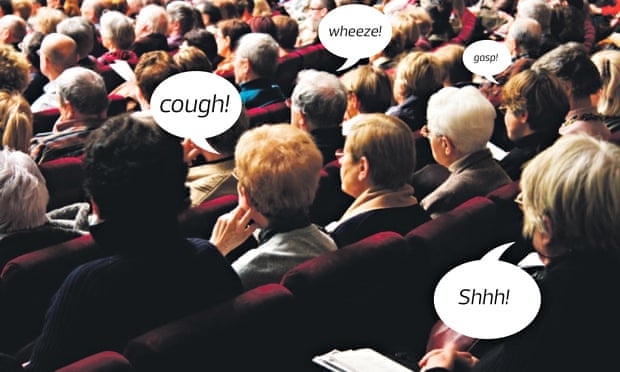 “In England, no-one goes to the theatre unless he or she has bronchitis”. This was the sardonic reference by James Agate, a diarist and former drama critic for (among others) the Sunday Times and the BBC, to the fact that it appears most people – at least until recently- cough far more during concerts than they do in normal life. Indeed, a report by the German social scientist Andreas Wagener on this issue published by the Association For Cultural Economics International (ACEI) has calculated that whereas healthy adults cough around 16 times in 24 hours, with an average concertgoer this increases to around 0.025 times per minute and so, at 36 times a day more than double the normal rate.
 Wagener has also observed that sneezes, hiccups and yawns are just as common as colds, but despite being more difficult to control are rarely heard during music performances, whereas “experimental evidence shows that humans are not only able to activate but also to switch off coughing on demand”. He’s provided as an example the occasion when the pianist Alfred Brendel interrupted a recital in Hamburg, exhorting his audience to “cough more quietly”, whereupon they all stayed perfectly silent for the rest of the evening.
The Director of the Common Cold Centre (CCC) at Cardiff University, Professor Ron Eccles, largely agrees with this analysis. On 9th September, he emphasised to Emma Barnett, the presenter of BBC Radio 4’s “Woman’s Hour” programme that although severe coughs are associated with common colds, asthma or respiratory problems, a simple tickle in the air passage can be voluntarily restrained for a while if we choose to do so. Most people, he pointed out, manage to suppress the urge to cough while there’s a moment of suspense in the theatre, then all start clearing their throats at the same time as soon as there’s a burst of applause.
A survey conducted by the CCC, sponsored by the medicine company Benylin, has measured most coughs at 70-90 decibels, “as loud as a noisy radio or an underground train”. Eccles has acknowledged that many people can feel irritated if someone nearby is coughing and be concerned that they may catch whatever the other person has. According to Dr Sabine Krajewski, Senior Lecturer in International Communication at Macquarie University in Sydney, Australia, this is even more the case now that “the way we sneeze and cough in public has likely changed forever” and become one of the “new taboos”. A study conducted in the USA by “One Poll” on behalf of the allergy relief company Flonase has revealed that 56% of those questioned feel judged if they sneeze or cough in public, even when they’re wearing a mask.
The Guardian correspondent Rachel Hall on 7th September cited the view of Simon Williams, a sociology lecturer at  Swansea University in Wales, that coughing is now stigmatised as a contagion risk. Furthermore, asserted Hall, it’s on the verge of “joining the list of unacceptably disruptive behaviours in theatres, along with excessive rustling, talking and using your mobile phone”.
Even before the onset of the pandemic, as YouGov research into the attitudes of public transport users in the Asia Pacific region revealed, in many countries coughing or sneezing without covering one’s mouth was already regarded as among the most annoying habits perpetrated by some fellow passengers, along with poor personal hygiene, talking loudly on a mobile phone, putting feet on seats and eating smelly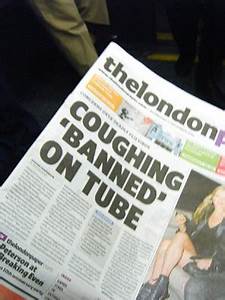 food. Most travellers in this situation tend to either give disapproving looks or move away from the offender if possible, but usually don’t react quite like the resident of Dayanagar village in Greater Noida, Uttar Pradesh who, according to the “Times Of India”, objected to a man coughing in the middle of a Ludo game, so shot him because he believed he was spreading the virus.
On 11th September, the BBC’s Emma Barnett, in an article for i News, declared that as a cough-hater, she’s “delighted that unnecessary spluttering has become  taboo”. She was careful, nonetheless, to emphasise what she sees as the distinction between those who are genuinely ill or have chronic conditions that make it difficult for them to stifle a cough and audience members who gratuitously do so “all the bloody time during live performances and
 the cinema, invariably at key points”. Before the pandemic, she noted, some theatres had started to hand out throat lozenges or hard-boiled sweets “in a friendly attempt to quell the racket”.
That seems no longer required. In an interview with the Radio Times, the Radio 3 presenter and BBC Proms Host Petroc Trelawny, cited by Barnett, happily speculated that the opprobrium now associated with potentially infecting others with covid has led to the vanishing of the cacophony of hacking noises that previously disrupted dramatic pauses in classical music productions.
 In the Sun newspaper on 4th October, the Digital Health Reporter Andrea Downey suggested a range of options for stopping a cough. They included: Placing a large scarf over your mouth “to create a warm cavern of air”, drinking tea infused with thyme or warm water with either apple cider vinegar or honey and lemon, gargling lukewarm salt water and (like the pre-pandemic theatres) sucking throat lozenges containing menthol or eucalyptus.