Keeping Cool In A Hotter World: The Environmental Risks:
 “The majority of British homes are just not equipped for high temperature events”. This observation by Andy Simms, a property expert
 with the MyBuilder organisation, quoted by the edie-com contributor Matilda Cox on 6th July, was prompted by the succession of heatwaves experienced across the UK this summer. Requests for domestic air conditioning (AC) installations, reported Cox, had “skyrocketed by 320%” over the previous few weeks. Likewise, Alex Baldock, the CEO of the electrical goods retailer Currys, confirmed to the Guardian journalist Sarah Butler that sales of
 its fans had increased by 3,000% and its AC appliances by 330%
The key problem, the Observer columnist, Lily Isaacs, noted on 28th June, is that for decades our living spaces have been designed to be energy efficient and air tight in order to keep the heat in during the winters. “Now we need the opposite”.
Dr Matthew Blackett, an associate professor of Physical Geography and Natural Hazards at the University of Coventry, however, told Cox that he considers air conditioners to be a short-term solution that might even inadvertently worsen global warming. That’s because the
  units simply blow hot air from inside a property into the streets outside, thereby raising temperatures in the area and also because they are already responsible for at
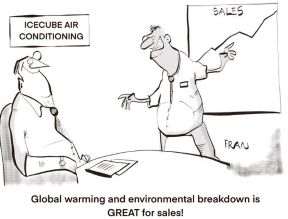 least 7% of global electricity consumption. As science insights.com has pointed out, hotter temperatures lead to more AC use, which produce more carbon emissions and so cause more warming.
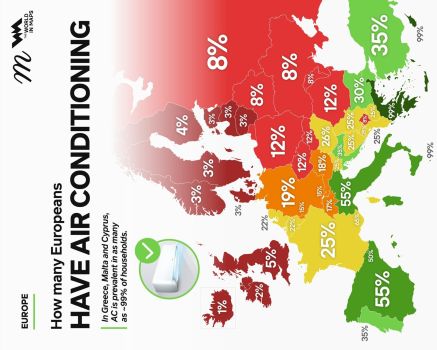
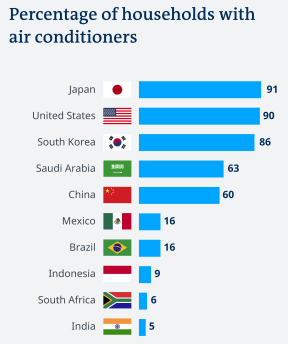
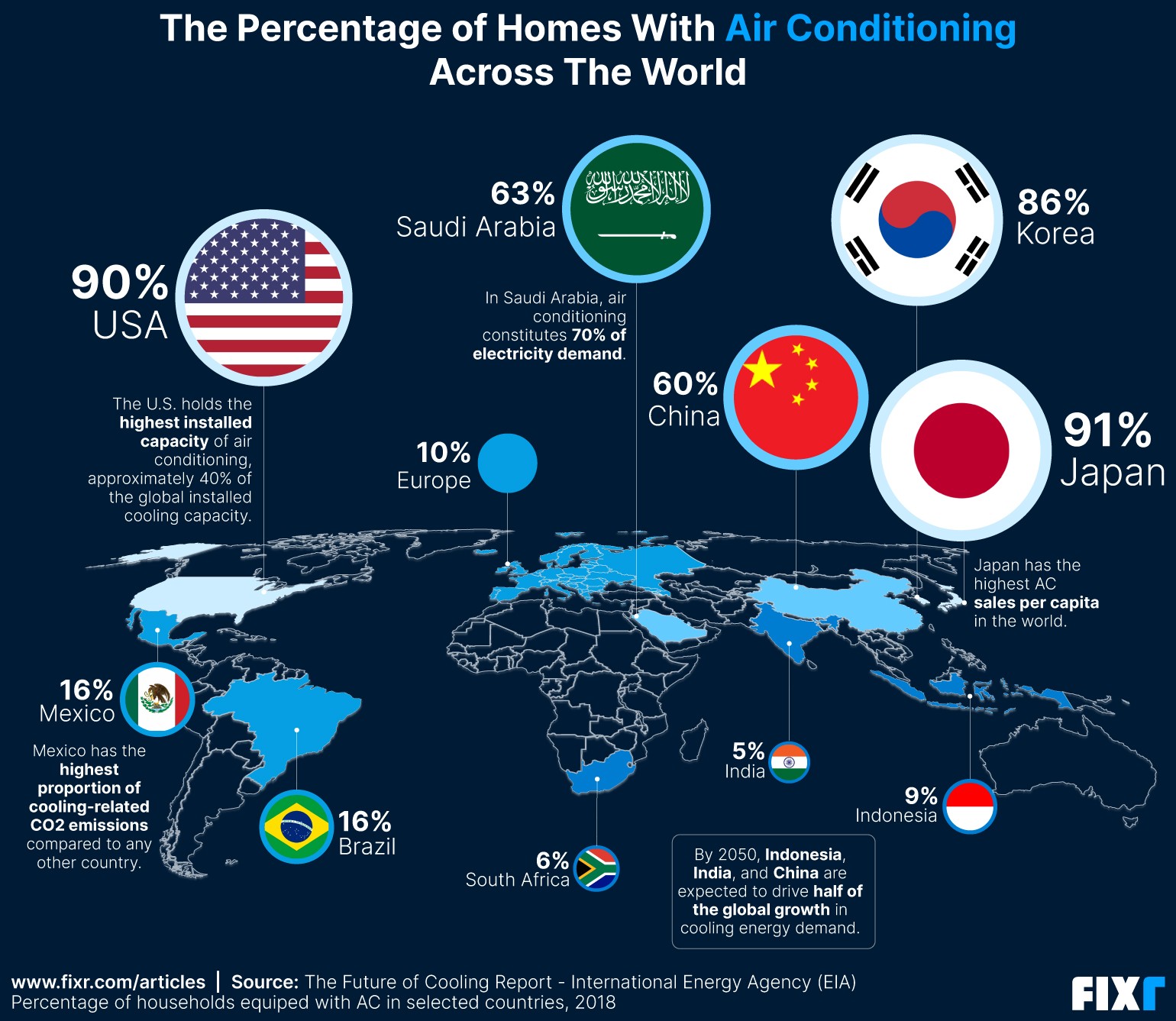
International Energy Agency 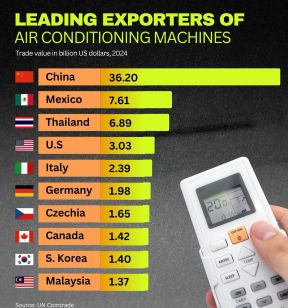 (IEA) data indicates that there is a “wide disparity” between countries regarding the number of households with AC. Japan tops the list with 91%, followed by the US (90%), South Korea (86%), Saudi Arabia (63%), China (60%), Mexico
 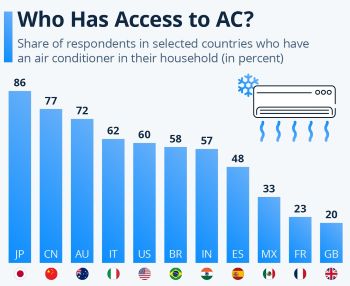 and Brazil (16%), Europe (10%), Indonesia (9%), South Africa (6%), India and the UK (5%). Although the French are depicted by the Guardian analyst, Fred Harter, as generally “frowning on AC as a vulgar US extravagance”, even there its use has risen to 48% in its southern provinces, though remaining at 10% in the north. The UK’s Climate Change Committee has meanwhile warned the Government that 92% of residences in this country are at risk of overheating by 2050 because they were “built for a climate that no longer exists”, and that AC should be
 integrated into all care homes and hospitals by 2036 and into all schools within 25 years.
According to the World Population Review (WPR), China is by far the largest AC market, selling around 53 million units annually, 41 million of which are for residential purposes and 12 million for commercial establishments. The US sells 24 million pa, Japan 11 million and India (well behind but catching up) 4 million pa. The WPR notes that,whereas – for cultural reasons – AC has become a normal and expected feature of everyday life in countries such as the US, Japan and South Korea, until now it’s been less common in Europe due to milder climates, older building designs, higher energy costs and an emphasis on limiting energy consumption.
 Global Market Insights Inc. anticipates that the international AC market will grow from $US 206.6 billion in 2026 to $US 361.2 billion by 2035, with the Japanese Dalkin Group being the dominant brand by revenue and technology and China’s Gree Electric Appliances leading by unit volume. The Asia-Pacific region is the largest for both production and demand.

775 rooms – AC mainly just in those used for State occasions, receptions & administrative purposes.
Tom Gill, a writer on sustainability and renewables for heatable.co.uk advises anyone considering purchasing a portable AC unit to opt instead for a wall-mounted one because (he says) they are better for the environment, are more energy efficient and are easier to control with smart thermostats. Also, people who think they can keep cooler without having to spend on an AC by just opening their windows are making a  fundamental error. If it’s hotter outside than inside, the warm air will be drawn into the house. A fan does use up less electricity than an AC appliance, but not if you leave it on all day thinking you’re saving money.
On 26th June, the Sunday Times correspondents Ben Spencer and Claire Irvin, reported that some four & five star hotels in central London, all of which have AC in their rooms, were experiencing an influx of guests checking in because their own nearby accommodation was much too hot.