In the Ascendant:The Global Impact Of The Spanish Language:
 “Be proud to be Latino and never lose that pride”. The Puerto Rican singer Benito
 Antonio Martinez Ocasio (stage name “Bad Bunny”) emphasised his commitment to his origins and his belief that “an artist should never forget where they are from” when he performed and spoke almost entirely in Spanish during half-time at the National Football League’s “Super Bowl” final at the Levi’s Stadium in Santa Clara, California on February 8th.
 This didn’t please the current occupant of the White House who ridiculed Martinez Ocasio’s show on the grounds that no-one could anyway understand he was saying. In fact, the Economist publication pointed out in it’s February 14th edition, this piqued response wasn’t at all
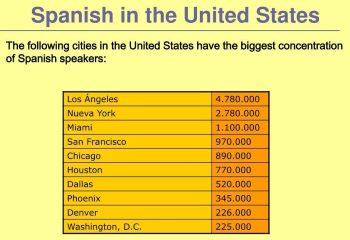
 accurate, mainly because a large proportion of the USA’s 40 million Spanish speakers will have been among the estimated 135.4 million people who watched the event globally. The rival “Turning Point” alternative, screened at the same time, attracted only 5.2 million viewers. Furthermore, stated the Economist, the USA is the world’s fifth-biggest Hispanophone country,
  though it also anticipates that, due to the current immigrant deportation policies and the assimilation process whereby ethnic communities gradually adapt to their local environment, this percentage could begin to decline.
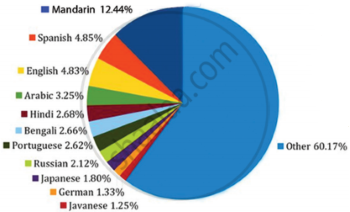
According to the “Babbel” commentatór, James Lane, on January 4th, there are 486 million native speakers of Spanish around the world, putting it behind only Chinese (1.3 billion) and ahead of English (380 million, though this doesn’t include the billion who use it as a second language), followed by Arabic (362 million), Hindi (345 million), Bengali (237 million), Portuguese (236 million) and Russian (148 million).
Recent YouGov data reveals that 30% of UK residents who currently only speak English but would like to learn another language would choose Spanish, 18% French, 10% German, 8% Ítalian and 3%-4% Mandarin. This confirms the trend highlighted by the PA Media correspondent Eleanor Busby whereby Spanish has overtaken French in popularity among GCSE (General Certificate Of Education) students in Britain. Ofqual (Office of Qualifications & Examinations Regulation) figures show that entries for French GCSE fell by 1.9% from 130,650 in 2024 to 128,155 last year, for German by 7.6% from 35,110 to 32,430 but increased by 1.6% for Spanish from 129,935 to 131,985. Likewise at “A-Level”: French and German down ( by 8.3% and 6.8%) but Spanish up by 1.4%.
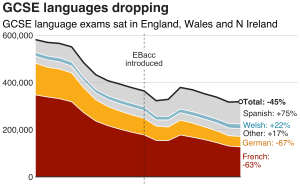 Vicky Gough, a schools advisor with the British Council attributes this to the growing importance of Spanish for international business and Pepe Di’Iasio, general secretary of the Association of School and College Leaders (ASCL) considers it almost certainly reflects the fact that young people and families in Britain frequently select mainland Spain, the Balearics and the Canary Islands as their preferred holiday destination.
In the Guardian on 10th February, the journalist Gary Nunn described Spanish as “clearly now the world’s coolest language” and queried why children in the UK are still being pushed to learn French. In his view, it’s mainly for historical reasóns, the proximity of France 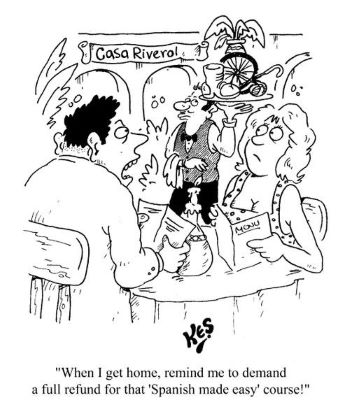 and the fact that it maintains 2nd place (after English) at the United Nations and for the Olympics. Nevertheless, he declared, it’s time for the curriculum to be changed to take into account the fact that Spanish will be more useful for students for their future employability, travel opportunities and “cultural credibility”. Híspanic musíc, he observed, ís having a major effect worldwide. He
 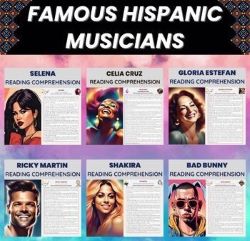 cited the Catalan singer Rosalia as an example, but could have íncluded countless others such as her compatriot Enrique Iglesias as well as “Bad Bunny”, Ricky Martin (also Puertó Rican), Shakira and Karol G (Colombia), Juan Luis Guerra (Dominican Republic) and Peso Pluma (Mexico).
The Forbes Lifestyle contributor, Meggen Harris,on December 15th took thís analogy even further. Latin American fashion, she declared, isn’t just havíng “a moment”, it’s  emergíng as the índustry’s next “Global Powerhouse” and the new generatíon of desígners from Colombia, Mexicó, Peru, Brazil and across the region is attracting the keen interest of the major international brands. Prominent among them, highlighted by the Dominican founder and president of Latin Fashion Week, Sobeidy Vidal, on January 15th, are Wílly Chavarria, a Mexican-American who “fearlessly celebrates his Chicano roots”, Fernandó García (the Dominican co-creative director of Oscar de
  la Renta), Maria Cornejo, a Chilean focusing mainly on minimalist geometric designs, Gabriela Hearst, a Uruguayan whose innovations reflect “conscious luxury” and Mexico’s “romantic revolutionary”, Carlos Pineda, acclaimed for his “dramatic florals, cascading ruffles and traditional embroidery”.
The freelance writer and “digital nomad”, Mike James, has observed that notable Spanish designers such as Pedro del Hierro, Paco Rabanne and Agatha Ruiz de la Prada, are also having a significant influence on the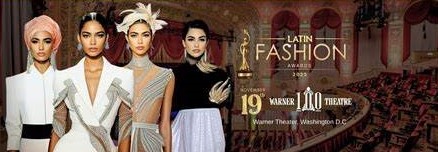 development of the international fashion sector. Similarly, brands such as Zara, Balenciaga, Manolo Blahnik, Massimo Dutti and Delpozo have not only made Spanish styles easily accessible but have become commercially powerful on a global scale.