The Risks Of Betting In The UK: Not Being Paid Even If You Win:
 “Gambling brought our family together. We had to move to a smaller
 house”. Gemma Bradley, a care assistant from Wakefield in Yorkshire, if she was aware of this joke once made by the British comedian, Tommy Cooper, is unlikely to find it amusing. She’d almost certainly identify more with the observation by the polemical American entrepreneur Robert T Kiyosaki that either you win or you learn, but never both at the same time.
 Mrs Bradley was just one of several thousand customers with the William Hill betting organisation who believed on March 16 that they’d won a “jackpot”. In her case, the amount was £33,000 following her participation in an online casino game. As quoted by the Mirror journalist Miranda Pell, she was crying with happiness because it meant she’d be able to
 pay off her mortgage. However, noted Pell on March 31, her celebrations hadn’t lasted very long. The company contacted her the very next day to demand the cash be returned, claiming it had been credited to her in error due to a “technical glitch”.
 Similarly, Claire Ainsley, a single mother from Liverpool, thought she’d won £1 million, a “life-changing amount of money”, was planning to take her children on holiday and then to buy a new house. She told the ITV breakfast show, “Good
 Morning Britain” that she’d been congratulated by the William Hill staff, was told the funds would be in her bank account within 72 hours, once she’d provided identification documents, but the money never arrived and that instead she was offered a consolation £39. In yet another example, postman Stephen Harvey from
 Dunstable in Bedfordshire was denied his expected prize of £330,906 for successfully playing an
  online slot machine activity, though was allowed to keep £200.
According to Philip Conneller, a contributor to casinoorgphilc, in addition to these three, there were estimated 35,000 people  in mid-March who were erroneously awarded wins connected to the “Jackpot Drop” feature at William Hill and 888, both owned by the
 bookmakers company Evoke. Jake Evans, a Next.io correspondent, has depicted the mistake as having pumped millions into customer accounts which William Hill have been desperately attempting to retrieve on the basis that they were not generated through valid or properly functioning game-play. The company insists that clause 8 of its Terms and Conditions allows them to void transactions
 if a malfunction has occurred, though many of its consumers have vowed to take
  legal action to protect their perceived winnings.
There have been plenty of precedents for such disputes. In 2021, Betfred were ordered by the High Court to pay out £1.7 million after they’d initially refused to do so and in 2025 the same court ruled that a gardener was entitled to a £1 million jackpot which had been contested by Paddy Power. Evans has pointed out that this latest “ unfortunate episode” has occurred at a particularly sensitive moment for Evoke, the owners of William Hill.
On April 19, the Sunday Times business journalists Oliver Gill and Daniel Woolfson reported that the company is £1.8 billion in debt and is currently negotiating a rescue deal with the American Rhode-Island based casino operator Bally, who are better known in Britain as the front-of-shirt sponsors of Nottingham Forest Football Club. On 31 March, Evoke announced announced that from 24 May it will be closing 200 (14.3%) of its
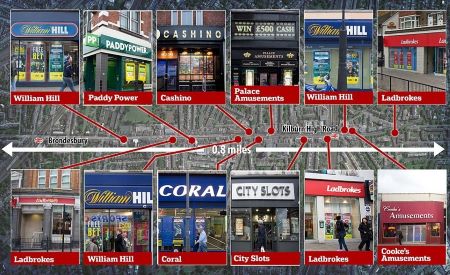 1,400 betting outlets across the UK. This reflects a continuing development which has been evident over more than twenty years, not just with William Hill but also its main competitors Ladbroke Coral, Betfred and Paddy Power.
At their peak,notes the UK Bookmakers (UKB) website, there were over 16,000 betting shops across the country, not hidden away in side-streets but located openly in town centres. Not any more. Even in 2009, there were still 8,872 of them, but since then the number has declined to 5,825. UKB have attributed this “culling of the
  industry” mainly to the increase in internet and smartphone betting, whereby “punters” can discreetly and anonymously place stakes from the comfort of their own home or indeed from almost anywhere and estimate that remote gambling in
 Britain now produces revenues of at least £14.4 billion a year.
Evoke is not the only one closing many of its shops. Ladroke Coral and Paddy Power are doing the same and Betfred have warned that this could happen to all its 1,287 outlets. The Labour Government’s 2025 Autumn Budget, which increased online casino tax from 21% to 40% from 1st April 2026 and General Betting Duty from 21% to 25%, effective April 2027, has added significantly to the pressure.
 Nonetheless, despite this trend, Boylesports have been opening up new sites rather than
 closing down existing ones. That’s because, in the opinion of “Which Bookie.com”, land-based venues remain a popular choice for many gamblers in Britain who prefer the social ambiance and the individual attention they receive at these locations to the impersonal and remote service available to them online.