How To Beat Inflation: Grow Your Own Food:
 We’ve all started to notice. The cost of almost everything has gone up and according to the Evening Standard’s political reporter, Rachael Burford, on 5th April, the price of staples such as milk, butter and bread could rise by approaching 50% in the coming months. This has been corroborated by the latest edition of the CGA Prestige Foodservice Price Index, quoted by the Morning Advertiser journalist, Rebecca Weller, on 17th March, which shows mineral water, soft drinks and juice up by 2.9%, fish up 2.6% and milk, cheese and eggs up 6.8%.

Chancellor of the Exchequer Rishi Sunak filling up a borrowed hybrid Kia Rio car.
As Richard Walker, managing director of the Iceland supermarket  chain, acknowledged on TalkRadio, these figures, combined with the increases in tax and fuel, present a major challenge for many families around the UK. So what are the options? Driving less and so reducing expenditure on petrol or diesel is a possibility, but not for people who need their cars for work or social reasons. Perhaps turning down the thermostat at home to reduce gas and electricity bills, at least until next winter.
According to a survey conducted across the UK by the Office For National Statistics (ONS), as the Guardian’s  economic correspondent, Richard Partington noted on 22nd March, 31% of adults questioned said they are now spending less on food. However, anyone who is fortunate enough to have a garden could follow the advice of the Royal Horticultural Society (RHS) by using it to grow vegetables such as potatoes, spring onions and carrots, which they wouldn’t then have to purchase at their local grocery shop.
They could also, as is pointed out in a factsheet issued by the Charnwood Borough Council in Leicestershire, even keep a few chickens in the garden to provide them with a regular supply of free, fresh eggs. There’s no law against that, 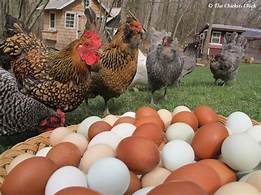 although DEFRA (The Department For Environment, Food and Rural Affairs) must be informed if the number of birds exceeds 50 and the neighbours are likely to complain to the health department of their town hall if there is an unacceptable level of noise or odour.
For those who don’t have a garden, or access to one, the only other alternative is to apply for an allotment. The problem with this, the London representative for the National Society of Allotment and Leisure Gardeners (NSALG), Terry Dickinson, told the SW Londoner contributor Stephanie Stapleton, is that in certain parts of the country demand for allotments has gone up by 500% with, in some cases, “a staggering17 years” elapsing before applicants have been able to obtain one

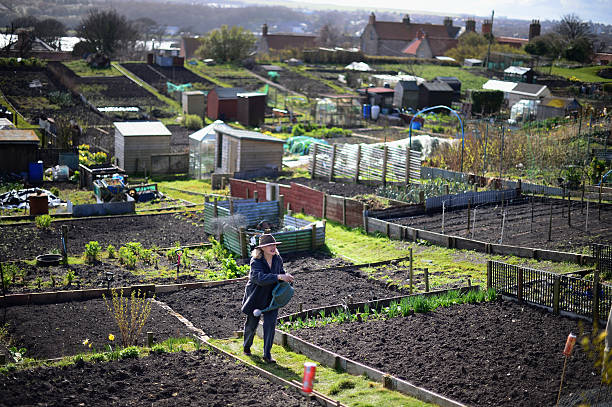
BERWICK-UPON-TWEED, ENGLAND
The British Heritage organisation confirms that there has been a nationwide renaissance in sowing and growing one’s own food and data provided by the NSALG secretary, Geoff Stokes, indicates that there are currently around 330,000 allotments around the country. Of these, 74% are “statutory” (land specifically purchased by local authorities for allotment use), 13% temporary (owned by local authorities for another purpose) and 8& in private ownership.

www.allotment-garden.org
The Power Shed retailer has estimated that there are around 90,000 people in the queue for one of these spaces, with the longest waiting list being in London, for example 637 for plots at Bushy Park in Richmond and 643 in Newham. The traditional size of an allotment is 302 square yards (253 square metres) , with 33% of local authorities charging at least £70 per annum to rent one and almost 70% more than £50.
 Why have allotments become so popular? The main reason, explains APSE (Association For Public Service Excellence) and the gardening commentator Hywel Davies, is the satisfaction of growing ones own fruit and vegetables. This coincides with a stronger awareness of environmental issues, global warming and hence that diminishing the amount of food imported from overseas consequently decreases one’s carbon footprint.
 The Allotment & Organic Gardening (AOG) website, nonetheless, warns that a minimum commitment of 10-15 hours per week is required for preparing the ground, sowing, planting and for endless weeding. It’s hard work, it emphasises, especially when the sun is beating down or it’s raining and the ground is heavy and water-logged. Things will go wrong. Sometimes pests will tear through whole crops so there’s nothing left. There’ll be plenty of disappointments, but at least, declares AOG, it’s a cheaper way of keeping fit than paying hundreds of pounds for membership of the local gymnasium.