The End Of A British Icon? : Good News For Canadian Bears:

For the Sun journalist, Lydia Hawken, it was an “awe-inspiring ceremony”. On 10th September, the Guards gathered in the courtyard of St James’s Palace, London, to hear the Proclamation of the new monarch, Charles III. They put their guns on the ground, took off their hats and held them in the air, declaring “God save The King” three times in unison. They then put their hats back on, picked up their guns and marched off.
 These soldiers were now the “King’s Guards” rather than the Queen’s, symbolising the start of the new era. But one thing hadn’t changed: their headwear. As the Daily Mail columnist, Matthew Bayley, commented the same day, the bearskin hats “have stood tall and proud as a British military tradition for two centuries” and have become synonymous with the splendour and pomp that tourists expect to see on show at Buckingham Palace, Windsor Castle and other principal royal venues.
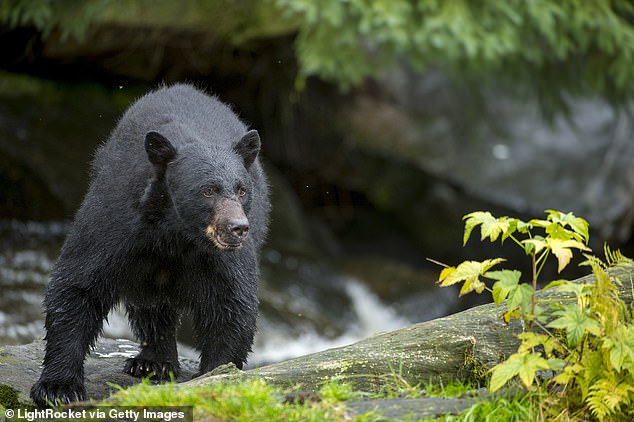
(Canadian black bear)
 Bayley also observed, however, that “the bearskin could be about to be toppled”, citing in particular the vocal protests by the PETA organisation (People For The Ethical Treatment Of Animals) and other campaigning groups likewise opposed to a situation whereby most of these hats, as the “Redcoat” website acknowledged on November 11th, are made from the skin and fur of black bears caught and culled in Canada. Each pelt (one bear = one hat), of which the British Army buys 100 every year, is estimated by Redcoat to cost around £650 and if looked after carefully can stay in good condition for at least another 80 years.

(Irish Guard with blue plume).
It’s not just the morality of the practice, though, which is now being

(Welsh Guards with white – green-white plumes).
questioned, but also whether these hats continue to be realistic and sustainable when temperatures in the UK are steadily increasing and reached a record of more than 40 degrees centigrade in parts of the country during the summer. According to “British Heritage”, some wearers of the hats – which are about 18 inches (45.72 cms) high and weigh roughly 1.5 pounds (688.388 grams) – say they are quite comfortable, light and cool, even though the chin-strap needs to be cinched fairly tightly and hence takes some getting used to.

(Buckingham Palace Guard being given a sip of water during July 2022 heatwave),
A former member of the Scots Guards, Chris Webster, has by contrast pointed out on “royal.hats.net” that when a guardsman faints during a long stand at a big ceremonial parade, it’s because the cord around his temple has contracted, so to avoid this happening they occasionally and discreetly flick their head slightly to release the pressure from the headband. The Guardian contributor, John Sibley, on the 5th November highlighted the widely publicised case of the Buckingham Palace guard dressed in the traditional red tunic and bearskin hat who, during the heatwave in July, had to be given a sip of water so he didn’t keel over.

(French Grenadier Guard)

(Napoleon at the Battle of Waterloo).
Royal Hats.net traces the origins of the bearskin hats back to the Battle of Waterloo in 1815 when the British 1st Regiment of Foot Guards defeated Napoleon’s French Grenadier Guards and adopted for themselves the large headpieces that the opposing (soldiers had been wearing to make themselves look more intimidating when confronting their enemies. The five regiments that continue to use them can be identified by the special coloured feather plume attached to their hats. For the Coldstream Guards, it’s red, the Grenadiers white, the Welsh white-green-white stripes, the Irish blue, while the Scottish Guards’ hats don’t have any plume at all.
 Furthermore, as the LBC radio news station has noted, each regiment tries to wear the bearskin differently in order to distinguish themselves from the others. The Blues & Royals, for example, wear the strap under the chin whereas the Grenadiers place it under the lip, apparently to avoid any of them being choked if they fall backwards during a battle.

(ECOPEL “faux fur artisan”).
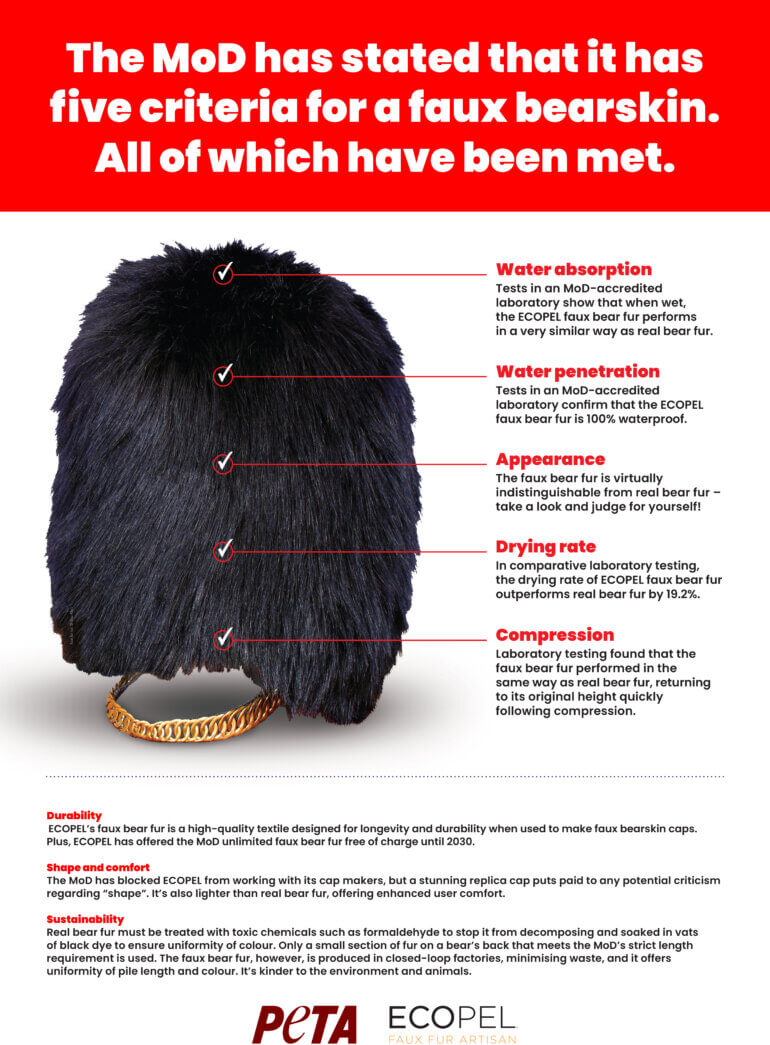 Redcoat doesn’t refute the fact that the use of bearskins is a hugely controversial issue and that many environmental activists, among them prominent fashion designers such as Stella McCartney and Vivienne Westwood, are demanding a switch to the option of “faux fur”. Indeed, Redcoat itself has published on its website data confirming that a petition launched by PETA in April 2022 has already received more than 100,000 signatures. Nonetheless, it also gives space to the British Army’s insistence that synthetic fur hats lose their shape in
 strong winds and become waterlogged in heavy rain.
These assertions are fiercely contested by PETA, who strongly favour instead

(PETA member demonstrating faux fur version of bearskin outside Buckingham Palace).
the faux bear fur manufactured by the ECOPEL company, a subsidiary of the Shanghai Haixim Group. This product, contends PETA< abides by all the Ministry of Defence’s (MoD) five stipulated criteria regarding water absorption & penetration, (appearance, drying rate and ability to return to its original height after being compressed. The MoD has been accused by PETA of “unacceptably blocking any chance of progress, while deceitfully telling the public that it would be willing to change were a suitable alternative provided”.