Sleeping In A Public Park Risks A £100 Fine:
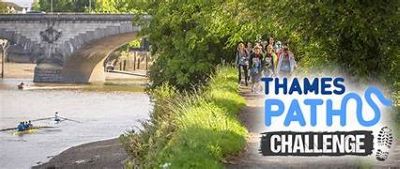 If you live in or occasionally visit the London Borough of Hammersmith & Fulham and have an electric scooter, this will affect you. As from 18th October, under the new Public Spaces Protection Order (PSPO) implemented by the local Council, using it along the pedestrian parts of the Thames Path has become illegal. The purpose is to “eliminate speeding and dangerous traffic behaviours” in the designated section and also applies to quad bicycles and hoverboards.
 Electrically assisted pedal cycles (EAPCs), however, are exempted as long as the power of the motor doesn’t exceed 250 watts and cuts off when the speed of the vehicle reaches 15.5mph. Anyone breaking this regulation will have to pay a fixed penalty of £100 (reduced to £60 if paid within 7 days) and repeat offenders could be fined up to £1000.
 As Rosie Brighouse, a member of the legal team at the
 human rights organisation Liberty, pointed out in an updated article on 18th September, PSPOs and CPNs (Community Protection Notices) were introduced when the Anti-Social Behaviour,Crime and
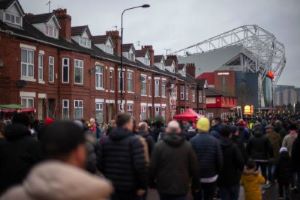
 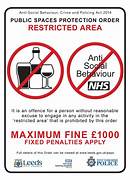 Policing Act 2014 (ASBCPA) gave local authorities the power to prevent individuals or groups carrying out “detrimental activities” in public spaces in their area. Since then, she notes, hundreds of PSPOs have been created, some of them relatively mundane, but many others “completely ridiculous”, such as trying to prohibit football fans on the way to watch a match at Manchester United’s Old Trafford stadium from using “foul and abusive language”.
On 20th July, the Guardian columnist Sarah Marsh observed that “the seemingly bizarre nature of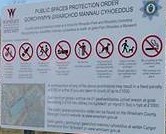 some of the fines issued under PSPO legislation” saw them increase from
 10,412 in 2019 to 13,433 in 2022, with some of the punishments meted out being for shouting, loitering, busking, swearing, feeding birds, “rough sleeping” or being asleep in a vehicle. Marsh cited a report compiled by Josie Appleton, the director of the Manifesto Club, which campaigns for freedom in civic life, insisting that the “thousands of petty restrictions which have been imposed” need to be scrapped or severely reformed”.
 Many councils, observes Appleton, are taking advantage of the 2014
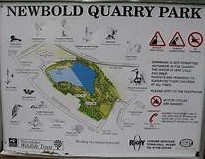
 Act to devise excessive and wide-ranging regulations that ban people from doing anything that potentially annoys any other person. Rugby Council, for example, has
  criminalised the climbing of trees at Newbold Quarry Nature Reserve “to protect and enhance habitats”; Wiltshire forbids the possession of
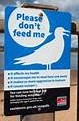
 stones “capable of being launched as a projectile by a catapult; in Rother and Welwyn Hatfield, it’s now an offence to have a nap in a park or sleep in a public place. According to the Dartmouth Chronicle, in Devon,”busybody misdemeanours” include feeding seagulls on Exmouth seafront, talking too loudly in Teignmouth and handing out leaflets in Barnstaple.
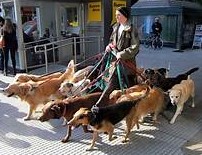
 In Richmond-on-Thames, Surrey, the number of dogs that can be taken for a walk by one person is now just four, although professional dog-walkers can apply for a permit for a maximum of six, with similar rules in force in Manchester, Pendle (Lancashire), Hammersmith and the London Borough of Hillingdon.
 This summer, it became a PSPO infraction to feed or
  pat the ponies in the New Forest, Hampshire, or to start a barbecue there .CPNs have likewise been deployed as sanctions against barking dogs in Sunderland, north-east England, “offensive hand gestures” in Kings Lynn, West Norfolk, while Mole Valley Council in Surrey has used one to admonish someone they considered to have too many cats.
 The Manifesto Club is particularly concerned about the growth in
 councils, especially those of Peterborough, Hillingdon and Bedford, employing private security companies to collect payments owed for a breach of a PSPO. Furthermore that, despite explicit Home Office guidance that the most vulnerable and impoverished sections of society should not be targeted, many local authorities are using the powers derived from the 2014 Act to prevent the homeless from begging and sleeping rough. Imposing fines, declares Appleton, is not the solution to the vagrancy problem.
 She’s also alarmed at the impact PSPOs are having on the right to free speech and free assembly, as they enable authorised officers or private contractors to break up any activity of which the council disapproves, such as a political demonstration, irrespective of whether or not the participants are behaving in an anti-social manner. Invoking a PSPO as a punishment for using an amplifier during a political gathering (Bolton) or against “persons congregating in a manner that obstructs other people in the vicinity”(Haringey) in Appleton’s view fundamentally undermines our rights of free
 association in public spaces.
The human rights commentator, Rosalind English, acknowledges there is a collision between the state’s responsibility for the smooth functioning of civil society and the right of citizens to draw attention to vital moral issues. Which do we support, she asks, “Freedom of physical movement or free expression of thoughts?”