Stolen Goods For Sale: The (Almost) Unknown Police Service:

 “Have you ever wondered what the police do with all the lost property that’s handed in and the items they’ve seized from thieves if they can’t return them to the owner?” The answer, as Hannah Wílliams, a contributor to savethestudent,org, pointed out on 23rd December, is that they sell them for economical prices at police auctions, so if you know where to look, you can obtain great bargains. And the best part of this, she adds, is that not many people even know about it.
 The other disposal options available to the police under the Proceeds of Crime Act 2002 are either to use it for training purposes, donate it to charity or destroy it. As Karen Jaundrill, a Detective Sergeant with the Financial Investigation Unit, emphasised to the Manchester Evening News, any money they manage to raise from sales goes either to good causes, victims of crime, or is reinvested in funding local police initiatives.
However, before any item recovered from criminals can be transferred to the “Evidential Property Services” (EPS) for auctioning purposes, the Investigating Officer in charge of the case or a senior supervisor (SIO) needs to be completely sure that it won’t be required in court as part of the evidence for the prosecution.
The way the system works is that if a member of the public discovers an apparently mislaid object in the street (for example, a wallet) and gives it to the police, they’re entitled (if they want it) to get it back if it hasn’t been claimed by the rightful owner within two months, but must then retain it for at least a year after it was first found.
 The “Money Magpie” correspondent Jasmine Birtles and her counterpart with the “Next Generation Investor”, Angeline Mbogo, have both provided comprehensive
 step-by-step guidance as to how to access and make a profit from government and police auctions. As they note, these are organised separately by each individual local police station, so only they can provide up-to-date information, either in person or on their website, when and where the next one will take place.
Many of them use trusted auctioneers located in their areas: For instance, the east London auction house Frank G Bowen Ltd acts on behalf of the City of London Police and likewise Hartleys in Liverpool L6 for the Merseyside constabulary. However, anyone purchasing an article in this way must also pay the auctioneer a buyer’s premium of up to 20% plus VAT on top of the initial selling price.

 Unsurprisngly, as “moneysavingsexpert.com” has pointed out, the most common categories of items available are the ones most usually retrieved from robberies – watches, cameras, jewellery and mobile phones – but can also include toys, books, clothing, shoes, household utensils, antiques, sculptures, purses and even pet supplies. Some police forces specialise in the articles they put up for sale: In Warwickshire, it’s mainly prams, ladies and children’s cycles, CDs, DVDs and videos, whereas in the West Midlands it’s electrical goods, tools and gardening equipment.
 Birtles and Mbogo particularly recommend Bumblebee Auctions.co.uk, as “a great place to start”. They portray it as a cheaper though less user-friendly version of eBay, but to register on it and then start bidding it’s necessary first to set up an e-money account with Nochex, (for a £2 administrative fee) which
 is the only payment system Bumblebee will accept. If your bid for a product is successful, you then have to inform the local police station when you’ll be collecting it, with advance notice of at least 48 hours usually required.
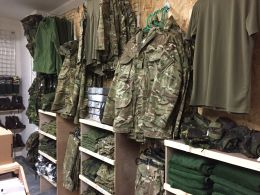
{British Military Surplus: Army Clothing & Boots}.
Birtles observes that not only is it not uncommon to find bikes worth £300 at Bumblebee for only £20 but it’s also sometimes even possible to acquire cars there for very little cost, albeit they tend to be in fairly poor condition. However, “if you fancy putting in some work and cleaning a vehicle up, you could make a real profit when selling it on to someone else”.
Anyone hoping to procure army clothing and equipment discarded by the Ministry of Defence (MOD) such as combat boots, ceremonial tunics and regimental towels, however, is more likely to locate them on the British Military Surplus website rather than at police auctions.
 The Driver and Vehicle Licensing Agency (DLA) conducts frequent auctions around the United Kingdom at which motorists can purchase personalised car number plates. Government organisations, local authorities, banks and
  building societies appoint designated auctioneers, for often considerably reduced prices, property that’s been repossessed due to the owner falling into arrears with their mortgage payments. But that’s another story.