“The New Status Symbol”: Home Interiors Open To the Public Gaze:
 What’s the purpose of curtains? The American novelist and socialite,
  Edith Wharton, once described them as “a necessary evil” used in badly designed homes. Most decorating companies, of course, tend to disagree and instead extol their virtues.In the opinion of “Furnishing Tips.com”, among the main advantages of curtains is that they control the amount of sunlight entering a room, significantly reduce airborne dust and external noise levels as well as providing insulation for the windows, hence lowering the cost of utility bills.

 Perhaps most important of all, they contend, is that even those made with lightweight material enable the occupants to enjoy the view but simultaneously minimize the ability for someone to see in from the outside. The wall-covering specialists Wallhub.com likewise depict them as offering a sense of protection, security, privacy and a restriction on unwelcome “prying glares”.
 However, it appears that the well-off sector of US society, unlike Wall-Hub, doesn’t feel the need to have a barrier between themselves and the outside world. On the contrary, as the Atlantic magazine correspondent, Michael Walters, reported on 22nd January, many rich people there now don’t cover their windows
 at all. If you walk round a wealthy neighbourhood at night, he observes, you might be surprised by how much you can see, perhaps a large flatscreen TV, a curved couch, a marble kitchen or a chandelier: “Of course (he acknowledges) some of the curtains are closed – but many are flung open, the home’s interiors exposed, like you’re peering into a showroom”
 Walters was citing the results of a US government study showing that Americans who earn $150,000 pa (about £120,000) are twice as likely to leave their windows uncovered as those earning up to $29,000 (£23,000).
The Evening Standard contributor Prudence Ivey and her CNN counterpart Katja Brokke, have both pointed out that this isn’t “just a US phenomenon”. Many people in Holland, for example, either don’t have curtains or blinds and even if they do, never close them. According to Brokke, the Dutch themselves don’t consider this unusual: “It’s so interwoven in their culture that researchers have struggled to figure out why people in the Netherlands care so little about their privacy”.
 The British, by contrast, have a reputation for being “generally quite private in their nature”. At least, that’s what the Expactica online guidance resource
  tells prospective visitors to the UK. This doesn’t, however, quite correlate with statistics from a survey conducted by the
 Burton Roofing company and highlighted by the Flux magazine contributor, Alexa Wang. This indicates that almost third of residents in Britain don’t close their downstairs curtains at night and that more than 60% of those aged over 65 don’t bother to do so even when they’re changing their clothes.
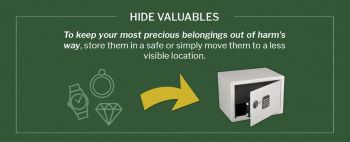 Brian Davenport, the owner of “The Solar Centre” has warned that this could pose a definite security risk, as it enables potential burglars not only to see whether there are valuable objects inside worth stealing but also to check the layout and best entry points to the property.
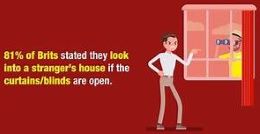 The Burton investigation has additionally revealed that 80%
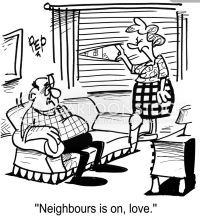
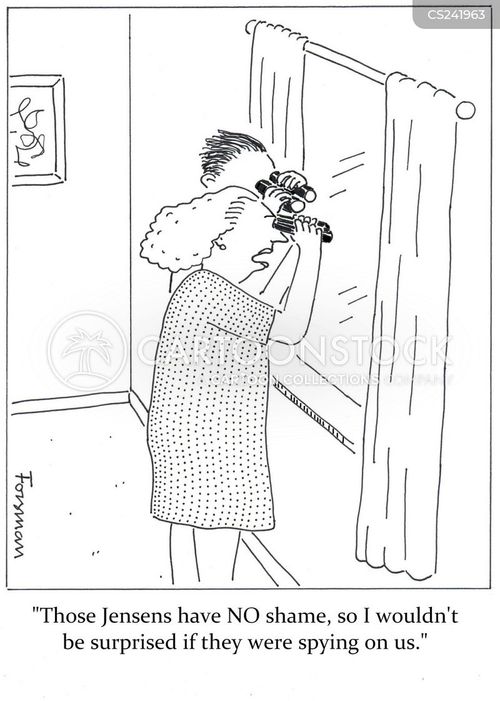
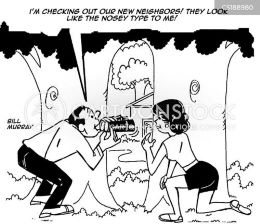 of people in the UK, when walking around their local area, will look through the windows of houses they are passing if the curtains are open. That’s because “we love to see how other people live and how this compares to us”. Nevertheless, the more traditional way of following what’s happening in the street outside has long been to indulge in “curtain twitching”, peeping through them (especially the ones made of net) without being seen oneself.
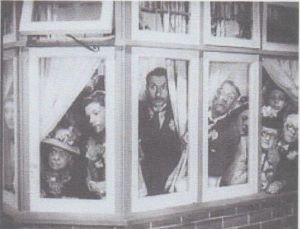 Research commissioned by Swift Direct Blinds has discovered that, for “tactical reconnaissance purposes”, nearly a third of “nosey neighbours” look through the
 same window in their home each time, while six out of ten prefer to switch windows to get a better view of the action. For some of them, Olivia Heath, a lifestyle columnist for Housebeautiful.com has noted, this doesn’t completely satisfy their curiosity, so 27% will turn down their TV or radio, open a window (21%) or put their ear to the adjoining wall (11%) to better hear an
  argument going on next door,15% will peek over the garden fence or pretend to be watering their plants to find out who’s visiting and 9% will use any possible excuse (for example, taking over a parcel that’s been left with them) to see inside the other house.
Furthermore, it seems that 35% would consider carrying out home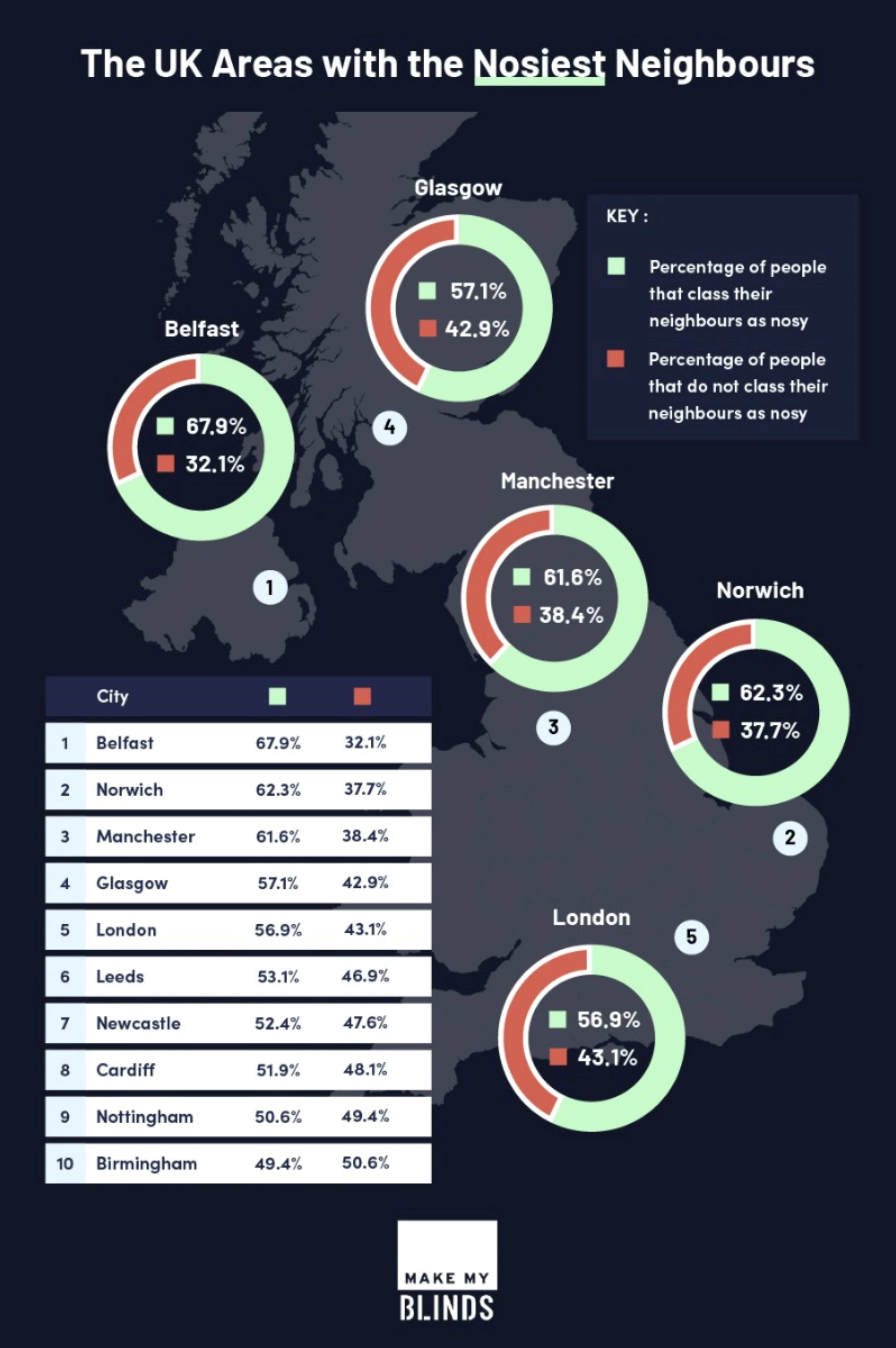 improvements, such as renovating their kitchen, to keep up with their neighbours and to ensure that the value of their property doesn’t fall behind theirs. The residents in Cardiff, Wales, have been classified by
  Anglian Home Improvements as Britain’s nosiest neighbours, followed by Norwich, Nottingham, Liverpool, Sheffield, Plymouth, Newcastle and Brighton.
The Daily Mail journalist, Mario Ledwith, has asserted that a third of the UK population is now using the internet to “snoop” on those living closest to them – in effect, that “curtain twitching” has gone online.