The Banning Of “Inappropriate Books”: A Trump Trend Reaching The UK:
 “Without books, the development of civilization would have been impossible”. This was the firm view expressed by the American author and two-times Pulitzer prize-winner, Barbara Tuchman, in her speech to the US Congress Library in 1980. She would have been encouraged by the recent report issued by the World Population
 Review showing that the United States was the country that in 2024 read and bought the most books. According to their statistics, Americans spend almost seven hours reading per week on average, equalling 17 books & 357 hours per year. They are followed by India (just under 7 hours pw, 16 books/352 hours pa), the UK ( 6.5 hours pw,15 books /343 hours pa), France (5 hours 50 minutes pw,14 books /305 hours pa) and Italy (5 hours 20 minutes pw,13
  books/278 hours pa).
According to the YouGov data journalist, Dylan Difford, on March 5th ,50% of UK respondents to a survey conducted by the organisation declared they read or listen to books at least once a week, 37% most days, 20% every day and only 15% admit that they never do so at all. The over-50’s and people living in middle-class households often have access to a much wider range of books at their disposal at home. Of these, 57% read them when going to bed, 56% in their free time during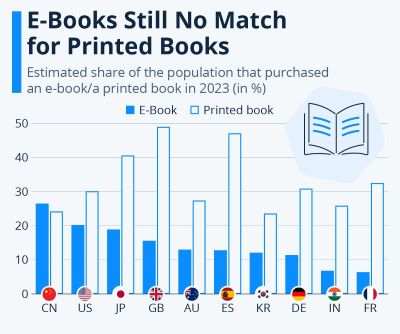 the day, 54% while on holiday and 19% while commuting to and from work.
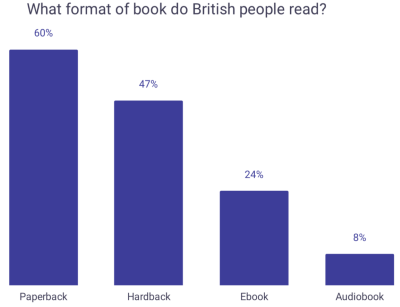
 Nowadays, as Difford notes, despite the increase in audiobooks and e-books, 61% of readers continue to prefer the traditional,physical form. He also referred to what he contends to be several “gender disparities”, namely that women supposedly have the tendency to choose fiction, such as crime and thriller novels, whereas men opt for non-fiction genres such as biographies and memoirs. Furthermore, that women purchase more second-hand books than do men and are twice as likely to borrow books from family, friends or a library.
 Obtaining books on loan from a library is not, however, quite as straightforward as it used to be. On 14th April, the Guardian columnist, Ella Creamer, observed that requests to remove books from library shelves “are on the rise in the UK as the influence of pressure groups behind book bans in the US crosses the Atlantic”, though here it’s mainly focused on publications with diverse gender orientation themes, whereas over
 there anything related to race, ethnicity and social justice issues is also targeted. Both Creamer and her colleague Alison Hicks on 17th April cited an Index on Censorship survey conducted in 2024 which revealed that 23 of the 53 librarians questioned had been asked to remove books and over half had done so due to fear of losing their jobs or being trolled online.
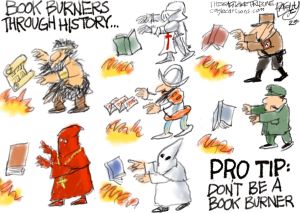
 As the Atma Unum website emphasises, this is not a new phenomenon. It happened as far back as the Chinese Qin dynasty (213-210 BC), in 1562 when the Maya codices were burnt on the
 orders of Bishop Diego de Landa, during Nazi Germany in the 1930’s and following the introduction of China’s national security law in Hong Kong in 2020. Russian military police are allegedly under orders to “seize and destroy” books on Ukrainian history and culture in the territories they have occupied.
In an article titled “What’s Happening with Book Bans Under
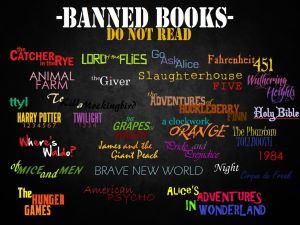 Trump?”, the NPQ correspondent Alison Stine has highlighted the growing alarm at the cuts in the federal grants to cultural institutions, including libraries, in the US who depend on them for their very
 existence and hence face uncertainty in their budgets, staffing and community programmes. Several leading publishers, among them Penguin
 Random House, Hachette, Harper Collins, Macmillan and Simon & Schuster have responded by proclaiming their dedication to protecting freedom of expression and the right to read. “We are unwavering in our support (they declare) for educators, librarians, students, authors and
  readers. Everyone deserves access to books and stories that show different
  perspectives and viewpoints”.
This battle has now extended to Trump’s attempts to dictate what American universities, prominent among them Harvard, teach and who they can admit, by threatening to freeze their substantial federal grants. Meanwhile, in the UK, 72% of adults in another YouGov survey believe that books should never be banned following a complaint and 12% consider this should only happen “after a great deal of complaints”.
On a more reassuring note, the International Book Fairs are not only surviving, 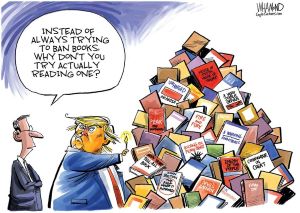 but thriving. The 2025 LBF (10-12 March) attracted 30,000 attendees, over 170,000 are expected at the “Buchmesse” in Frankfurt (15-19 October) and the “Feria Internacional del Libro” in Guadalajara, Mexico (29 November – 7 December)is the world’s second largest. So, despite Trump, there’s still plenty of scope for optimism in this sector.