Posture & Presence: How Global Leaders Maintain Their Power:
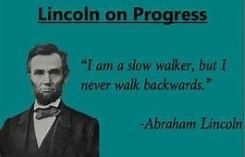 “I’m a slow walker, but I never walk backwards”. This remark. attributed to Abraham Lincoln, US President from 1861 – 1865, is generally regarded as reflecting his determination never to retreat or give up once he’d made a decision (such as abolishing slavery). One of his biographers, Albert Kaplan, has described how Lincoln moved around with caution, firmness and an even tread, His personal mannerisms “encapsulated his robust philosophy of intentional action”, shaping
 perceptions of him both at the time and ever since.
As the mAd MiNds organisation pointed out in a YouTube video clip  on 15th March, the physical styles of people in charge can project an aura of confidence, authority or approachability when they enter a room, even before they’ve uttered a word. Their body language in effect often reveals more about their objectives than whatever they’re about to say. Some will proceed promptly to the podium, others will greet well-wishers along the way, a few will keep their eyes focused exclusively straight ahead.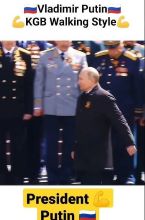
Russian President Vladimir Putin, it seems, belongs to this last category. A study in the British Medical Journal has concluded that Putin’s distinctive “Gunslinger’s / Clint Eastwood strut”, whereby his left arm swings freely but his right arm remains static”, is derived from his training with the Soviet KGB. Apparently, as the Daily  Express journalist Mataeo Smith has observed, the purpose was to enable operatives to draw their gun as quickly as possible when confronted with a foe. In the same video, French President Emmanuel Macron is depicted as being assertive, energetic and even elegant when accompanied by his wife Brigitte while Chinese President Xi Jinping’s “upright bearing” conveys the impression of control and stability.
At a recent rally in Kentucky, reported by the Huffpost contributor, Monica Torres,on 22nd March, President Trump acknowledged that he descends wet stairs very carefully to avoid slipping but claimed that Barack Obama’s way of doing it had been more “unpresidential”. Although he has often also mocked  Joe Biden’s tendency trip over, Trump’s own gait was characterised by the Health Digest contributor Cole Hediger on 25th November as being “curiously pigeon-toed”,with his feet turning inwards, not forward, when stepping, thereby reigniting questions about his well-being. According to the New York Post columnist Richard Pollina, in his final year in the White House, Biden was flanked by aides in order to block cameras from filming him shuffling and stumbling.
For the British author, Matthew Beaumont, walking is far from being a neutral activity. On the contrary, in his opinion, it is “irreducibly political”.Which is why The Times newspaper has highlighted the fact that so many British Members of Parliament have increasingly resorted to what it dubs the “Westminster Walk-And-Talk” whereby they stride  purposefully towards the camera to delivery punchy narrative on the latest contentious issue. Dr Christian Jarrett, the editor of the British Psychological
 Society’s Research Digest, however, cautions that, despite the potential immediate impact of a “pavement pitch”, it can either look like a desperate attempt to make an impression or lead the viewers to make false judgements about the person appearing on their screen.
 Indeed, whether it’s possible to accurately identify individuals based on their movement patterns has, according to the National Library of Medicine in Bethesda Maryland, USA, long fascinated society. The rapid development of AI has made
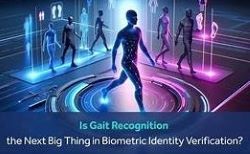 this much easier. Rather like fingerprints, leg length, muscle flexibility, joint mobility and overall body structure (states info@feet.co.uk)
  together provide each person with a distinct walking style which can be detected by surveillance tools now being deployed in many parts of China.
“You don’t need people’s cooperation for us to be able to find out who they are”, the CEO of the computer data company Watrix, Huang Yongzhen has told the Associated Press
  correspondent Dake Kang. That’s because gait recognition devices can’t be deceived by someone pretending to limp, hunching over, turning their back or covering their face because the software analyses features of the whole body and can function at a distance of 50 metres away. As Kang notes, there is growing
  concern about how far this technology will go.
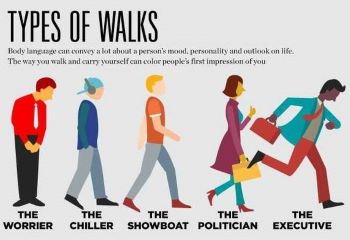
Meanwhile, studies conducted by the Advanced Telecommunications Research Institute International in Kyoto, Japan, cited by the Guardian’s Science Editor, Ian Sample, on 18th March, have concluded that how people walk is a definite indication of how they are feeling. A large arm swing suggests they are in an angry mood, a smaller one that they are a bit despondent. If they have their hands in their pockets, this could mean
  they are dissatisfied with the way they look or with the clothes they are wearing. Those with heavy footsteps have persistent personalities but can be inflexible in their attitudes.
A YouGov survey has revealed that 42% of respondents between the age of 18 – 49 classify themselves as fast walkers, whereas 44% of 65 year-olds and over reluctantly accept they are now much slower. Another 12% either don’t know or haven’t given it much thought.