How The “Silly Season” Has Become A Year-Round Phenomenon:
 When there were rumours that extra-terrestrials had landed in deepest Alaska, the bureau chief of the World Wireless Service (WWS)
 in Omaha, Mr Williams, immediately rushed off there to investigate. Although the flying saucers had disappeared by the time he arrived, he sent off his report about them anyway to his New York office because, as it was the summer , they needed material that would attract major national attention. However, when he went back the following year because his local contact, Edwin C Benson, has assured him the aliens would return, it had lost its novelty and was no longer considered to be of any interest.
An excerpt from Steven Spielberg’s latest film “Disclosure Day”? No, it’s the narrative of a short story titled “The Silly Season” written
 by the american futuristic author, C.M. Kornbluth, which was published in the Magazine of Fantasy and Science Fiction’s 1950 issue. The point that Kornbluth was trying to make was that Williams was under pressure to produce something significant for WWS (a fictional organisation) even if it was completely invented.
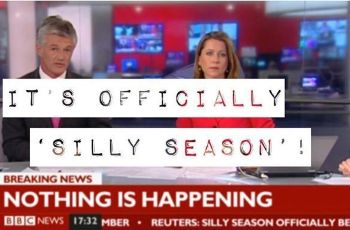
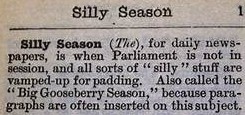
The concept that there’s a period of the year when nothing really happens so publications have to fill their pages with light-hearted, humorous and often improbable incidents dates back 160 years to when it was first mentioned in the Saturday Review on 13th July 1861. As the communications specialist Alan Anstead has noted, the terminology was given formal recognition in the 2nd edition of the 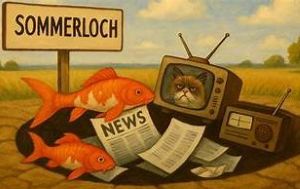 “Brewer’s Dictionary of Phrase and Fable” in 1894 , being defined as the months when Parliament, the Law Courts and the political institutions are in recess and media outlets are obliged to search for alternative content.
Although Anstead depicts this as an “annual custom deeply ingrained in British journalism culture”, he acknowledges that many European countries also have a similar tradition. In Norway, Hungary, Holland, Denmark and the Czech Republic, for example, it’s known as “pickled cucumber time”, in Germany “Sommerloch” (summer news hole), in France, “the dull or conker-tree season”, in Sweden “Nyhetstorka” (news drought) and in Spain “serpiente de verano” (summer snake ).
 Charley Nash, a cypersecurity expert and accounts manager for Eskenzi PR, however, questions whether it’s reality anymore. The political situation both at home and abroad, he points out, is now far more unpredictable and global issues such the Russia – Ukraine war, the Strait of Hormuz, the spiralling cost of living everywhere and the climate warming crisis all continue to dominate the headlines irrespective of whether Parliament is in
 session and much of the population is on holiday. The “Rocketeer” contributor, Sarah Light-Waller, has furthermore observed that, until the end of the 1950’s, although the public didn’t always trust the traditional press they were still disposed to believe what they read. No longer, mainly because there’s now such a vast range of different versions of the news available, hence which one is regarded as”correct” depends very much on the attitudes of the person accessing them.
The Australian commentator, Andrew Mueller, has expressed regret on the Monocle cultural website that “journalism has lost its high- summer lull”. In his view, these days it’s
  always silly season, especially on social media where we are permanently vulnerable to a frivolous or inane scroll from someone, somewhere. It doesn’t help, he observes, that “Earth’s most powerful individual is an incessant source of silliness, which we are obliged to take seriously because of the office (in the White House) that he holds”.
Yet, despite the ubiquitous nature of modern communications, emphasises Dr Craig T Robertson, a professor at the Reuters Oxford Institute for the Study of Journalism, that doesn’t mean that holidaymakers in the Algarve or Tenerife are glued on their smartphones to what’s happening elsewhere in he world. On the 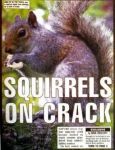 contrary, he cites research indicating that there is a growing trend towards avoiding any news which is overtly political, overwhelmingly negative and seems to have little relevance to their own personal lives.
Alan Anstead highlights the fact that anecdotes about animals invariably receive most media coverage in the summer. He provides, as examples, the apparently drug-addicted squirrels running around and creating havoc in the London borough of Brixton in 2005, the 272 occasions one August when seagulls allegedly swooped down on people strolling along the sea-front to steal their fish and chips or their ham and cheese sandwich and the celebrated case of Yvonne the cow in 2011 who escaped the abattoir, wasn’t recaptured until 1st September and was then relocated to a
  sanctuary for the rest of her days. There are also more claimed sightings of the Loch Ness Monster in Scotland than at any other time of the year.
On 8th June, a photo appeared in the Metro newspaper of a St Bernard dog, Louie, being driven around in the sidecar of a Honda motorcycle wearing a helmet and goggles and on 10th June the UK media applauded the rescue of an Alsatian dog, Bruce, that had been swept out to sea on an inflatable kayak near the Farne islands off the north-east coast of England.