At Risk Of Shortages: Security Personnel For the Catwalks:
 “Fashion may renew itself every six months, but one thing remains the same: Bouncers always wear black”. So the Brazilian author and
 journalist, Paulo Coelho, once observed. Furthermore, in the opinion of the renowned London-based but Portuguese and Belgian-educated photographer, Barbara Anastacio, quoted in the Guardian, most of these men (“they are almost always men”) invariably have the best-fitting suits, amazing hairstyles and act as symbols of discipline and order amidst the chaos, frenzy and the glammed-up models. It’s funny, she reflected, that while everyone else is trying to look as different as possible, the bouncers are the ones, with their charisma, authority and patience, who stand out. According to Anastacio, “Paris has the most handsome. New York the biggest, Milan the toughest – and London the most polite”.
 These “stoic guardians of the shows” were once again to be seen from 11th -13th June supervising the queues outside the British Fashion Council’s (BFC) Newgen venue at the Old Selfridges Hotel, 400 Oxford Street W1, for the Labrum London, Robyn Lynch and Ahluwalia catwalks. This summer-time version of London Fashion Week (LFW) showcased new designs for both men and women and constituted ”a slimmed-down schedule across 20 physical and 14 digital activations”.
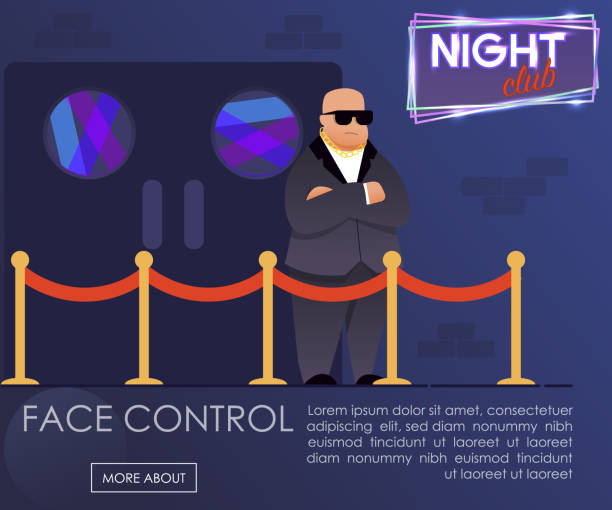
Professional Face Control at Night Club: Big Bouncer, Serious Male Guard in Formal Suit Stands at Nightclub Entrance Outside. Vector Illustration
As the news.uk contributor, Sophie Gallagher, however, has pointed out, events such as these no longer have access to the same security resources that were available prior to covid and indeed the UK Door Security Association (UKDSA), the trade association for licensed bouncers, had already, back in March 2021, issued warnings about the likely shortfall.
 In the 22nd May edition of the Observer newspaper, its business correspondent, Sarah Butler, noted that statistics issued by the Night Time Industries Association (NTIA) had indicated that 75% of nightclubs, pubs and bars have insufficient security staff and thus shut down in the early evenings or entirely on Mondays,Tuesdays and Wednesdays.
Moreover, that although there are 250,000 licensed door security staff in the UK, 24,000 of whom are women, many had moved on during the pandemic and found other kinds of work with more sociable hours. On 25th May, Michael Broomhead, the Digital Publishing Editor of Wales Online, highlighted the growing alarm in hospitality circles that this situation, combined with the rising cost of living, could result in many of their businesses closing down altogether.
It’s evident that a substantial number of new recruits need to be attracted into the private security sector, but first it’s mandatory for them to obtain a Security Industry Authority (SIA) licence. The fee for applying for one is £190, they must be at least 18 years old, undergo identity and criminal record verification, then take a course, the length of which will depend on the type of work they’re looking for. It will be six days, at a cost of £199, for a role guarding retail, office or premises authorised to sell alcohol, 4 days and £180 for “static
 guarding” or key-holding and just three days, also for £180, to be a CCTV operator or participate in public space surveillance.
The “Legal Match” website defines a bouncer as a person providing security services for the bar or nightclub by which they have been hired. They are not, however, categorised as security officers, and must only use force in self-defence , at a level appropriate to the circumstances. The job tasks permitted by law include asking an individual to leave the establishment when justified, refusing entry to a prospective customer who appears to be visibly intoxicated, and applying their right to make a “citizen’s arrest” of someone in the process of committing a crime, though this must be witnessed personally by the bouncer.
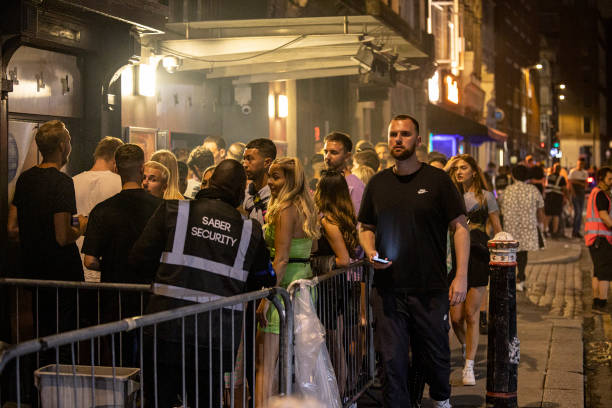
Club-goers queue outside Fabric nightclub on July 24, 2021 in London, England. (Photo by Rob Pinney/Getty Images)
The chief role of doormen, crowd controllers and bouncers, declares UK Rules.co.uk, is to make sure that members of the public are safe while they are enjoying themselves. That means they need to keep a “cool head”. They have the right to search a person wanting to go in so they can check whether they are carrying drugs or an offensive weapon, but this must be restricted to bags, pockets and outside clothing, whereas a “strip search” requires consent, must be conducted in private and in the presence of an independent witness. Private enterprises such as nightclubs, emphasises UK Rules, can choose who they do business with, so can legally ban anyone from their premises if they wish to do so.