Persecuted Or Pests? Britain’s Prolific Pigeon Population:

 “Almost universally disliked and often described as ‘rats with wings’”. That’s how the Westminster-based Cleankill company depicts the estimated 18 million feral pigeons which, according to totalbirdcontrol.co.uk, can be found across the country. Although they aren’t as nasty or aggressive as gulls, asserts Cleankill, their droppings pose a major problem, hence the range of deterrents available such as hanging netting over sections of
  buildings where the pigeons like to perch, or using spikes, sprung wires and gels. They are, Total Bird Control observes, almost a British institution, but when they descend on urban towns and inner cities are considered by many to be highly unsanitary and a complete nuisance.
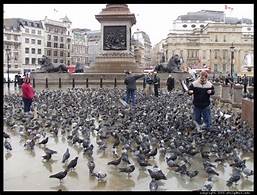
 Not everyone, however, shares that opinion. Back in 1996, seventeen
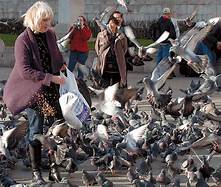
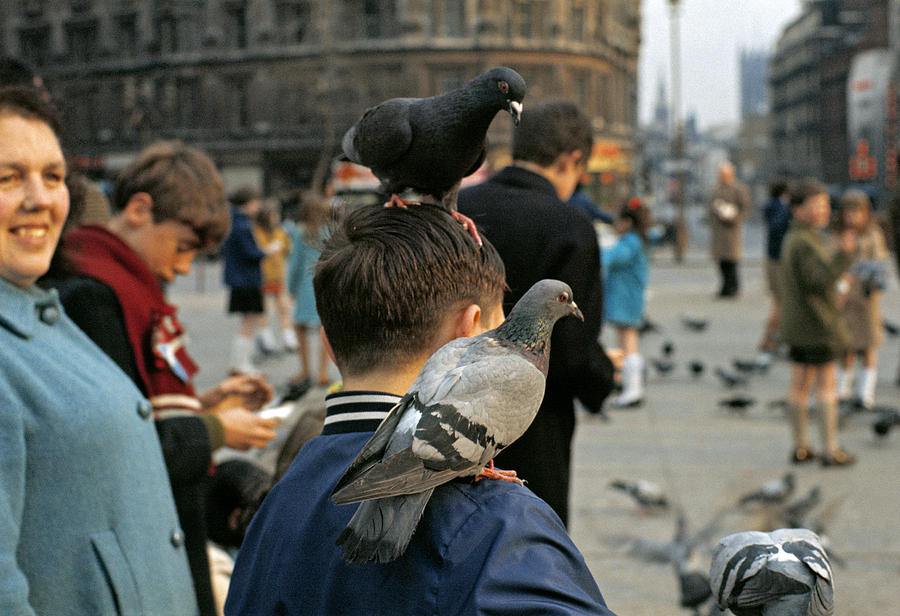 members of Parliament, among them the future labour party leader, Jeremy Corbyn, submitted a motion opposing any plan to eliminate pigeons from Trafalgar Square. These intelligent and gentle creatures, they declared, attract tourists, provide employment for the sellers of pigeon corn, are less likely to transmit disease to human beings than dogs or cats and should be considered friends rather than enemies.
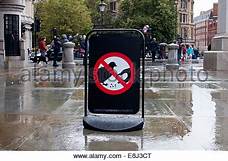 The Mayor of London at that time, Ken Livingstone, disagreed,
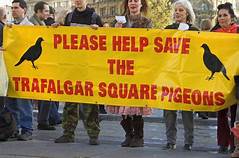 claiming that the pigeons’ acidic waste was causing £140,000 worth of damage to Nelson’s Column. When in 2001 he withdrew the licences of all the bird food sellers and paid people to blast the pigeons with loudhailers, a group of animal lovers responded by setting up an organisation called STTSP (Save The Trafalgar Square Pigeons) and scattering 25kg sacks of seed around the area, which Livingstone countered by bringing in a huge industrial vacuum cleaner to remove it all.
 Westminster Council subsequently introduced not only a £500 fine for anyone
 attempting to feed the birds but also – as highlighted by city-guide.london – a couple of hawks, at a cost of £60,000 pa, “to patrol the skies like fighter jets”, which scared the pigeons away and reduced the numbers down to around 100. This latter idea was then adopted in 2018 by Palace of Westminster chiefs in order to stop pigeons from nesting on the roofs of the Houses of Parliament.
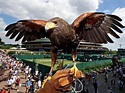
Rufus The Hawk At Wimbledon
Likewise, as the Guardian contributor Sirin Kale noted in a two-page feature on 7th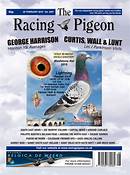 July, Rufus the Hawk , owned by Wayne Davis, a specialist with Avian Environmental Consultants in Corby, Northamptonshire, has for years been keeping the Centre Court at the All England Lawn Tennis Club in Wimbledon (AELTC) clear of pigeons during the Championship fortnight. As soon as they see Rufus, they recognise he’s a threat to their existence and move away. However, as Kale indicates, Rufus is at risk of being replaced by drones, which are increasingly being used to drive away birds at vineyards and airports.
 Nevertheless, pigeons have received particularly vociferous support from “Change.org”, which has launched a petition advocating that they should be treated with kindness and
 respect and that the abuse of them in public places should stop. Pigeons, the petition proclaims, still help in vital communication and sea rescue operations due to their brilliant eyesight which enables them to see colours at a great distance, hence should be given full protection under the law, as sentient beings.
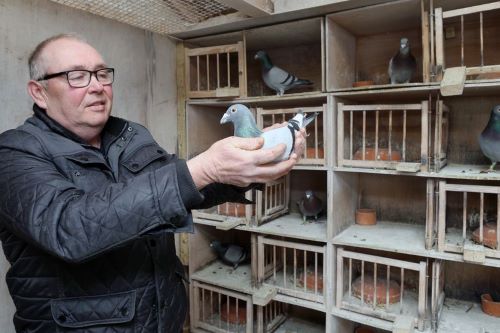
Alan Todd of Winlaton Homing Society at his pigeon loft near Blaydon, Gateshead
Change.org rejects the “spiteful rumour” that pigeons are a health hazard, which has been deemed as untrue by vets and the RSPB (Royal Society For The Protection Of Birds) and “has been spread by pest control companies who want to profit from pigeons’ demise”. It regards pigeons as good-natured birds that can identify letters of the alphabet, have exceptional navigational skills and helped save the nation during its darkest days of war.
 Indeed, even the Cleankill company has published data on its
 website acknowledging that pigeons continue to be practical for conveying messages in military conflicts because they aren’t affected by electronic jamming and are still used today by the French, Swiss, Israeli, Iraqi and Chinese armies.
 Meanwhile, the Guardian columnist Esther Addley reported on 8th July that pigeon racing is “hugely threatened” by post-Brexit EU regulations which specify that any competitive bird entering Europe must undergo veterinary checks even if it will then fly back immediately to the UK when released. Ian Evans, CEO of the Royal Pigeon Racing Association (RPRA) told Addley that this is having a significant impact on many of the 18,000 people in Britain who race pigeons, a large proportion of whom are elderly or retired.