Vibrant London Fashion Week Defies Retail Sector Gloom:

(Rihanna at the Superbowl: February 23rd 2023)
 “British fashion must speak to a country in paralysis”. This was the urgent message that Jonathan Anderson, the House of Loewe’s creative director, conveyed to the Guardian’s fashion editor, Jess Cartney- Morley prior to the start of the latest London Fashion Week (17th – 21st February). There’s no denying, he declared, that Milan and Paris have become dominant and hence the “lower profile” of LFW doesn’t provide the publicity platform for growth on the scale achieved by Loewe following the appearance by the singer Rihanna (whose boiler-suit was designed by Anderson) at the Super Bowl National Football League (NFL) final in Arizona on 12th February.

CONNER IVES CATWALK

MARRKNULL
However, Anderson, who is Northern Irish, insisted that he’s proud to be in Britain and hence is doing what he can to keep talent here at a difficult moment. The country is in a different place, he emphasised “We can’t hide behind history and heritage”.
The British Fashion Council’s (BFC) advance evaluation of the event varied somewhat from Anderson’s. In it’s “Value Of Fashion Report” published in January, it estimated the sector’s total contribution to the UK economy to be over £37 billion and that 816,000 people are employed by it across a wide range of jobs. Furthermore, that its influence extends far beyond the sales of clothing at high street retailers and department stores to product lines such as perfumes and homeware. It was thus understandable that on 16th February, the BFC’s new chair, David Pemsel, quoted by the Evening Standard journalist, Lizzie Edmonds, chose to focus on the UK’s renown for unique, anarchic creativity: “That’s what we want to showcase”.

NOKI x 2
 This LFW, nonetheless, has taken place in extremely challenging economic circumstances. It’s not only due to the fact that, as Peter McVeigh, the director of Donaghys Shoes, has told the Retail Gazette, February can be one of the quietest months of the year, hence retailers don’t always benefit as much as they hope from this early spring event. It’s also because a recent YouGov survey has confirmed that the cost of living crisis has forced people across the UK , apart from the well-off, to reduce their expenditure on almost almost everything. This includes eating out (39%), beauty services such as hair cuts and manicures (29%), cosmetics ( face cream, perfumes, mascara: 25%),alcohol (27%), toiletries (toothpaste, deodorant, shampoo: 25%), going to the cinema (22%), digital TV subscription ( for instance, Sky, Virgin Media, Netflix, but not including their TV licence: 19%).

ASAI
At the top of the list, however, are the 44% who say they have cut back on their clothing purchases, either by buying such items less frequently (29%), switching to cheaper alternatives (10%), or stopping spending on clothes altogether (8%). These statistics tally with predictions in the Mintel Clothing Retailing Market Report 2022 that consumers will remain cautious throughout 2023 due to continuing inflationary factors, among them the probability that apparel retailers will increase prices in an attempt to protect their profit margins.
Indeed, there were already signs of this back in October, when BBC News reported that the Asos company, which owns Topshop and Topman, had lost 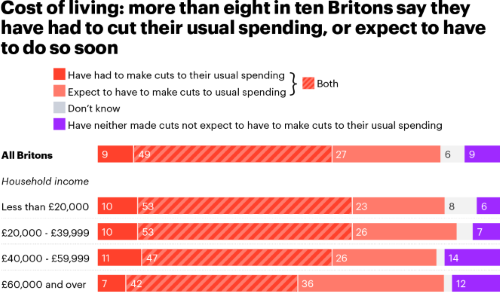 £32 million in the 12 months to August, compared to a profit of £177 million in 2021 – just one indication among many, Samantha Mansfield, Head of strategy and commerce at the “Customer Experience & Management Agency” Merkle, told the BBC, that “times are tough and brands are struggling with sluggish sales”. The fashion industry is also having to contend with Mintel data indicating that 58% of adults in the UK have bought second-hand clothes over the past year or intend doing so in the future.
 It was thus no coincidence that the official start of LFW was preceded
 in the evening of 16th February by what the Evening Standard contributor Nicole Mowbray portrayed as “From Vogue to Vintage”, a Fashion Fighting Poverty Show put on by Oxfam and the stylist Bay Garnett featuring only second-hand clothes displayed by, among others, the models Daisy Lowe and Erin O’Connor. The online “thrift store”, ThredUp, which specialises in high-quality second-hand clothes,
 expects the global fashion resale market to grow 127% by 2026.
 Another trend likely to unsettle fashion retailers is the “Buy Nothing Movement”
 which, according to the British Council, originated in Canada in the early 1990’s then moved to the USA where it became a rejection of the overspending and overconsumption of Black Friday. On “Buy Nothing Day” (this year November 24th), member groups participate in protests and cut up their credit cards. During the rest of the year, they organise the exchange and repair of items they already own.
 Despite Cartney-Morley acknowledging that Brexit, a “scandal-mired Westminster” and
 a looming recession have made it difficult to sell “Brand Britain” on the world stage, Drapers Online have been effusive about many of the catwalks, particularly those featuring designers such as Sinead O’Dwyer (Ireland), Dimitra Petsa and Karoline Vitto (both from Greece), Connor Ives (USA), Kay Kwok (Hong Kong), Natasha Zinko (Ukraine) and Edward Crutchley (UK).