Fancy Dress Costumes: Observing Cultural Sensibilities:
 “If the Government declared tomorrow that fancy dress parties were banned,
 nobody would mind”. That’s because, according to the British comedy novelist, Nick Spalding, no-one really likes going to them. You spend weeks beforehand (he declares) worrying about what to wear and how much it’ll cost you. You eventually find a leather jacket that looks slightly like the one worn by Harrison Ford in the Indiana Jones films or “one of those mass-produced garments that fall apart before you’ve even arrived at the party”, where you immediately realize that everyone else’s is a hundred times better than yours”.
 Spalding isn’t alone with this view: The Newcastle University student, Siobhan Fuller, has acknowledged in the campus publication “The Courier” that ”In the rush to acquire something to put on that night, you end up spending half your food money on wigs, props, tutus and feather boas”, hence she prefers to stick with her “trusty pair of jeans” and so save the cash.
Exactly what costume Fuller could have chosen is anyway likely to have been influenced by the trend in
 recent years among many student unions (SUs) across the UK to prohibit certain types of fancy dress. Edinburgh’s was the first to designate as “inappropriate” any outfits resembling mexicans, gangsters, arabs, Pocohantas (the daughter of the north-american Powhatan tribe’s chief in the 16th century), cowboys and indians, or Nazis. The Kent SU then attracted considerable media attention by issuing similar
  guidelines, warning its undergraduates not to use props such as maracas, but deeming as “acceptable”the portrayal of cave people, extra-
 terrestrials, cartoon characters and ancient Greeks & Romans. Sheffield’s SU banned somberos because (in its opinion) they “mock and demean mexican culture”.
 The justification for all these proscriptions was that fancy dress themes should not be centred around stereotypes and that students “should be mindful of whether any offence could be caused”. Ruth Langsford, a presenter on the Channel 5 TV consumer entertainment programme “Do The Right Thing” subsequently contended in response that “Dressing up and having fun is now under threat”.

 In March 2022, Eleanor Peake, a contributor to vice.com, queried whether fancy dress shops were on “the verge of extinction”. She cited statistics issued by the Local Data Company revealing that between 2020-2022, 36 of London’s costume shops had closed down, mainly because there products had not been required for parties during the pandemic. Despite this, her assessment was that the remaining establishments in the
 capital would persevere, confident that they’ll continue to be needed. Indeed, the Mobcater website has predicted that the the demand for fancy dresses among adults and children will grow “exponentially”, inspired by Hollywood “blockbuster” movies such as Star Wars, Batman ans Spiderman: “People are now spending big money on transforming themselves into their favourite fictional Hollywood character and having a lot of fun doing so”.
 Furthermore, emphasises “StartUpBizHub”, the public impression that this sector is only profitable at Halloween is mistaken, since the demand is all-year-
 round. That’s why “Mad World”, from their basement emporium in Tabernacle Street EC2, also cater for,
 among many others, Christmas pantomines and festivities, Scotland’s Burn’s Night (25th January) Valentine’s Day (14th February), St Patrick’s Day (March 17th), Chinese New Year, the Goodwood Revival (“a celebration of classic cars from 1946-1966”: 6th-8th September) and Oktoberfest. “Mad World” have reported an upsurge in requests for Ken & Barbie and Willy Wonka outfits.
StartUpBizHub highlights the fact that, although most new fancy dress businesses usually begin by hiring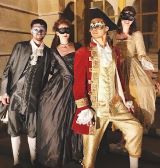 out only memorabilia from popular movies, they quickly realise they also have to stock a much wider selection, including circus, halloween, fairytale and pirate apparel as well as imitation body parts, wigs, assorted headwear, fun jewellery and neckwear, accessories and even fake weapons.
 Some people, observes “Britain Explained.com” like fancy dress so much that they join special groups such as the Sealed Knot Society (recreating historic European battles) or the Dickens Fellowship (remembering the 19th century
  English novelist Charles Dickens) and meet regularly in costumes. Amber
 Butchart, the author of “The History of Costume in England”, points out that “rituals involving disguise and costume are a feature of most cultures around the world and are an integral aspect of the history of humanity”. She notes that not only are “mainstream costume events” thriving in the 21st century, but that there’s been a resurgence of traditional English festivals such as “Obby Oss” in Padstow, north Cornwall and “Jack ‘O The Green”in Kingston,Surrey (both on May Day) and “Straw Bear” in Whittlesey,Cambridgeshire (13th January).

 Meanwhile, anyone who wants to go to a party dressed as a Christmas tree can obtain the costume from Amazon for £26.22, a Brown Reindeer zip-up jumpsuit with face-hood for £29 and a luxury Santa Claus outfit for £44.39. Among the many other options are to turn up looking like a Christmas pudding (Smiffy’s.com: £21.99), a Giant Pigeon (orion: £60.59) and (from FancyDress.com) either as a Hedgehog (£40.99) or a Dinosaur (inflatable version: £61.99)