Britain’s Digital Dilemma: Personal Liberty And The “Surveillance Society”:
 “A national ID card is a total contradiction of what a free society is
 all about”. The American author, activist and physician, Ron Paul, has thus expressed his staunch opposition to what has become a standard requirement in most countries around the world. There are a few exceptions: ID cards are not mandatory in, for example, Australia, New Zealand, Norway, Denmark, Ireland – or the UK, although the current Conservative Government, having previously rejected them, is now considering implementing a digital version.
 On 5th April, the Yahoo News contributor, Jimmy Nsubuga, published the results of
 research conducted by the media platform indicating that 79% of its readers agree with the former Labour Home Secretary, David Blunkett, that compulsory ID cards should be introduced to reduce the number of immigrants crossing the English Channel in small boats. Furthermore, noted Nsubuga, a YouGov survey in 2023 showed that 54% of UK residents are in favour of compulsory ID cards for every individual in the country, 55% support CCTV cameras in all public spaces, 50% accept that a record should be kept of all citizens’ fingerprints and that phone manufacturers should be obliged to assist the security services in unlocking password- protected devices.
Indeed, on 7th April, the Observer journalist, Martha Gill,cited the Social Market Foundation’s contention that the priority for people in Britain is “administrative efficiency” and that they largely approve of policies that “crack down on their freedoms to gamble, smoke, drink and consume food that is bad. Gill also believes that if the Labour Party takes power after the General Election (probably in November) and decides to bring in ID cards, it will have the consensus of the majority of the population.
 Not everyone, of course, shares Gill’s views. The Financial Times
 correspondent, Sebastian Payne, has highlighted the fact that the strongest argument against ID cards is that they would “fundamentally reshape the relationship between citizens and the state”. Having to carry one at all times and make it available it on demand to someone in authority is not, he notes, a very British tradition: “Many find the idea of being instructed to ‘show your papers’ at any moment appalling”.
 That’s similarly the opinion of the “NO2ID” campaigning
 organisation, a “single issue group focused on the threat to liberty and privacy posed by the rapid growth of the database state”, which they portray as “the tendency to use computers to manage society by watching people”.
The policy and campaigns manager for the Liberty organisation, Gracie Mae Bradley, has even more stridently dismissed the UK’s online ID plans as “expensive, intrusive, unnecessary”. In a Guardian article, she emphasises that it isn’t about a “philosophical position on privacy”. Combined with biometric records and facial recognition, she argues, a digital ID system would take us perilously close to the state being able to track, record and share with others huge amounts of information about all of us.
 On 22nd February, the former Labour Prime Minister, Tony Blair, and the former Conservative Party leader, William Hague, produced a joint report urging everyone in the UK to obtain a digital ID card as part of a “technological revolution”, as this would make it easier and more secure to access essential services. They assert that this transition can take place with compromising civil liberties or data privacy.

Neil C Hughes, a Senior Technology Writer for techopedia.com, acknowledges in
response that in pursuit of modern  conveniences, we often sacrifice the protection of our data. Hence all online transactions, from social media posts to online shopping, generate a trail of data that various entities can harvest, analyze and potentially exploit. Consequently, navigating this digital identity dilemma requires a delicate balance between protecting personal data, enhancing the personal experience and respecting individual rights, all in a climate of growing political mistrust.
 Paul Inglis, a commentator for the ForgeRock access management company is not
 convinced that the UK is ready for a formal digital identity card. He considers the key issue of trust must be resolved first by giving citizens securer control of their data so they can decide what gets shared with whom and eliminating the need for passwords, thereby reducing the risk of attacks on accounts. Meanwhile, he calculates that most people in the UK already possess some form of photographic identification that they’ll need, for example, if they want to vote in the local elections in England on May 2nd, such as a driving licence, passport, biometric immigration certificate, blue badge or Freedom Pass (which provides free travel to anyone aged 66 or over).
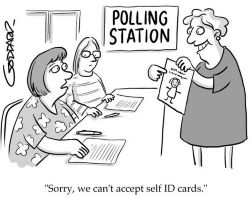 The Democracy Volunteers (DV) organization, however, points out that not
 everyone has such wide-ranging documentation at their disposal. When they monitored the May 2023 local elections (the first in England requiring voters to provide proof of identity) they found that 1.2% were turned away either because they didn’t have the correct ID or lacked any at all. Of these, 53% were “ethnic or non-white”. In effect, concluded DV, they had been disenfranchised because they were from “marginalised communities”.