The Impact Of Cash Donations On The UK Election Result:
 “Friends, we don’t want to worry you, but we need to share
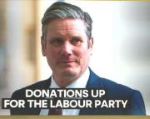 this with you”. This was how David Evans, General Secretary of the Labour Party, began an email he sent out on 2nd June to actual and potential supporters. He then went on to express his concern that the “huge surge in donations” in the first week of their election campaign had slowed down significantly, was “worse than expected” and was making them uneasy at HQ”. This was followed almost every day thereafter with requests for a minimum donation of £3, on the basis that it was the only way they could keep up with the fundraising by the Conservative Party.
What wasn’t mentioned , however, was the fact that – as the inews
 correspondent Cahal Milmo, highlighted on May 23rd_ the disparity between the “financial muscle” of the two main parties, has been somewhat levelled out by changes to Electoral Commission (EC) rules restricting the total amount any party can spend during an election. Last year, the Government increased this by 80% from £19 million to £34 million, purportedly “to reflect factors such as inflation” but which rather obviously, the Liberal Democrat campaign director, Dave McCobb, told the Financial Times contributor, Anna Gross, “would benefit the party that institutionally has the most money”, Nonetheless, added Milmo, although the Conservatives have traditionally enjoyed a higher rate of income from benefactors, “2023 was a particularly lucrative year for Sir Keir Starmer’s Labour, which raised some £13.6 million in individual contributions, a record amount for the party”.
 An analysis by the “Open Democracy” commentator, Ethan Shone, on 13th March of the sources of funds for the UK’s political parties in 2023 has calculated that, despite the “bleak economic landscape” across the country, together
  they received more than £93 million compared to just £52 million in 2022 and that the money “continues to pour in”. The Conservatives obtained the most (£44.5 million), followed by Labour (£21.6 million), the Liberal Democrats (£6 million), the Green Party (£610,000), Reform UK (£255,000) and
 the Scottish National Party (SNP: £76,000). On top of this were provisions for items such as premises, staff costs, sponsorship and consultancy service, worth £4.2 million in total.
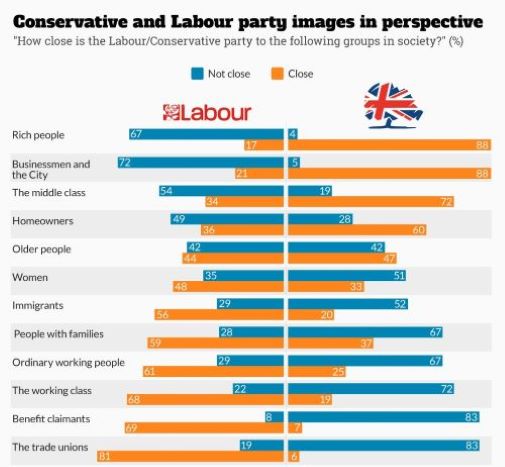
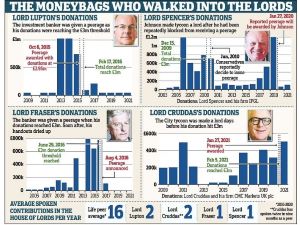 Perhaps because Labour is expected to trounce the Conservatives on 4th July (by 44% to 19%, according to recent YouGov calculations). Shone has focused on what he depicts as the increasingly close relationship between Labour, big business and the wealthy. While the trade union movement, its traditional financial backer, contributed just £5.9 million in 2023, Gary Lubner, former CEO of the vehicle glass repair company Belron, gave £4.6m and David Sainsbury £3.1m. Some critics (among them left-wing members of the Party), notes Shone, might feel that the interests of trade unionists and
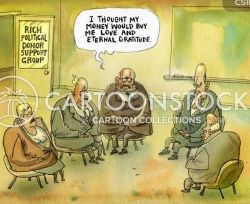
 “tycoons with the deepest pockets” don’t always coincide. Indeed, as the Indian politician and activist Atisha Marlena Singh has observed, the problem with political parties accepting funding from large industrialists is that they are then obliged to bow down to the demands of those same individuals.
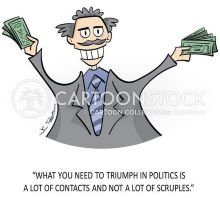
 Not that this ever seems to have bothered the Conservatives, as is evident from their acceptance in 2023 of the £10m bestowed to them in the will of Lord John Sainsbury. There was also £10 million from Frank Hester, the controversial owner of the Phoenix Partnership healthcare company who, the Guardian’s Whitehall editor, Rowena Mason, reported on 8th June, is bankrolling about 40% of the Conservatives’s national spending in the election and last year arranged for Prime Minister Rishi to take for free a helicopter flight that would normally cost £15,900. Among their other donors are Mohamed Mansour, the Egyptian-born billionaire boss of the conglomerate Mansour
  Group (£5m), Graham Edwards,co-founder of Telereal Trillium, which owns thousands of UK properties plus approximately 60 million square feet of land (£2m) and Amit Lohia, son of billionaire petrochemical and fertilizer magnate Sri Prakash Lohia, chair of Indorama (£2m).
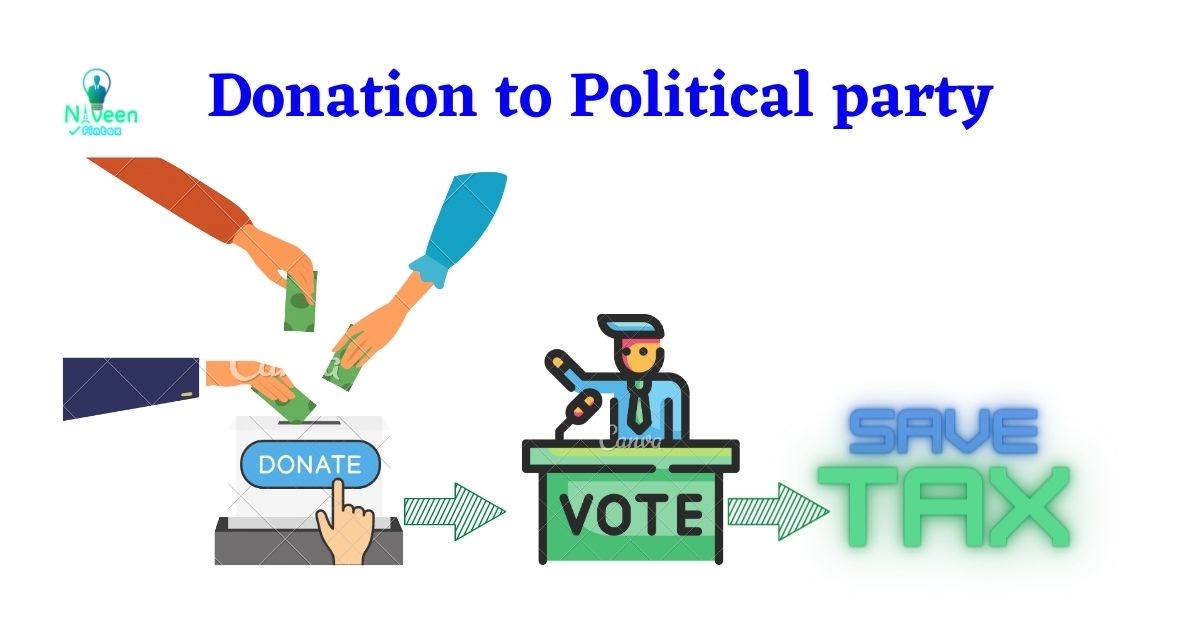
 The current EC regulations, the Press Association journalist Jonathan Bunn has pointed out in the Evening Standard, specify that although there’s no limit to the size of contributions, they must be made from “a permissible and identifiable source” and can only be from individuals who are on the UK electoral register. The parties can spend the money how they choose and can return it to the person who gave it to them, which the Conservatives have
 been urged to do in the case of Frank Hester. From 1st January 2024, parties have been required to declare donations of over £11,180, compared to the previous threshold of £7,500, whereas amounts less than that are outside the scope of the PPERA (Political Parties, Elections and
 Referendums Act 2000), so don’t need to be recorded or reported.
The spending limit for individual candidates is £11,390 + a variable amount based on the number of registered voters in the area where they hope to be elected. In a rural constituency, it’s 12p per voter, so if there are 72,021 of them (explains the EC), that’s £8,642,52, which means the candidate has a total of £20,032,52 at their disposal. When the election is over, they and their agent have to submit full details of their expenditure and from where the money originated.