Goodbye Marlboro: The Vaping Phenomenon Sweeping Britain:

 “Our mission is to refresh the world and make a difference”. That’s what the Coca Cola company proclaims to be its main objective – in addition ,of course, to selling globally as many cans and bottles of its products as possible. Its energy drinks counterpart, Red Bull, has an equally nebulous vision (apart from the profit motive), namely to “give wings to people and ideas”. Starbucks assert that their aspiration is to “inspire and nurture the human spirit”.
 However, if your priority is simply to “find tranquillity, freedom and a breath of fresh air” then, according to the Narratologist website, taking up vaping will provide the solution. That’s exactly what increasing numbers of people across Britain have started to do. According to a recent analysis produced by the ASH organisation
 (Action On Smoking And Health) the proportion of the population using e-cigarettes has risen to 9.1%, the highest rate ever, which equates to 4.7 million adults in the UK. Of these, 2.7 million (56%) are ex-smokers and 1.7 million (37%) current smokers, who have either already quit their habit, wish to do so or are finding cigarettes too expensive (the VAPE superstore estimates that 20 a day costs £112 per week) so have switched to vapes.
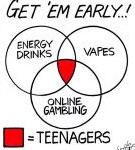
Among the 320,000 who have never smoked but just felt like giving vaping a try, the majority are aged 16- 24 , though the ASH statistics also indicate that there’s been a 50% increase since 2022 of 11-16 year-olds experimenting with them. The big 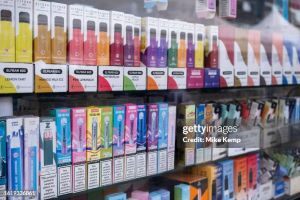 attraction is the wide range of colours and flavours on the market, with one teenager telling the BBC Health Reporters,
 Helena Bailey and Philippa Roxby that she likes the fact “she can buy one to match her outfit on a night out”. The extensive list of “vape juice options” that are now available, published by the coloradoclassic.com organisation on January 8, includes strawberry, blueberry, watermelon, mango, kiwi, guava, menthol, peppermint and dragon fruit, which explains for them why vaping has become such a popular alternative to smoking.
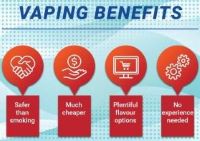
For anyone tempted but hesitant to indulge, Vape UK provides a beginners’ guide as to what is involved, namely inhaling and exhaling vapour containing nicotine and/or flavouring
  using a device that creates steam instead of smoke. In 2003, they observe, a Chinese pharmacist, Hon Lik, realised that smokers who wanted to give up their addiction needed something that would mimic their “hand-to-mouth fixation”, so invented the concept of “e-cigarettes”.
Vape UK points out that, although there is a “stupendous amount of variety” when it comes to the size, shape, colour and design of vape kits (as they are now better known), they all contain the same four key components. These are the mouthpiece, where you inhale your vapour; the tank / pod, where the e- liquid is held and surrounds the coil. By law,
 this chamber is restricted to a maximum of 2ml. It can be refilled with the selected vape juice, except for disposables; the coil, which when heated by the battery in turn heats up the e-liquid to create vapour; the lithium-ion cell which powers the device and is either pre-charged in disposables or is rechargeable with a USB for all other kits.
 BBC TV’s Panorama programme has noted that health experts and scientists tend to take the view that vaping is substantially less harmful than smoking because there are far fewer toxins in vapes than in tobacco smoke. Professor John Britton, an honorary consultant in respiratory medicine at the University of Nottingham, is however less convinced. “If you don’t use nicotine in any shape or form”, he told the BBC, “it’s madness to start vaping”.
 There’s particular concern regarding disposable vapes, which have grown
 rapidly in popularity due to their simplicity and (so ASH data confirms) are the preferred type for 57% of e-cigarette users aged 18-24. The problem with this, asserts vapegreen.co.uk, is that there’s an “alarming quantity” of prohibited ones in circulation in the UK: “If you see a 5000 puff disposable vape with a 5% nicotine strength for sale at your local corner shop (it declares), you can safely assume it’s illicit or contraband”.
During the “King’s Speech” in Parliament on 17th July, as the Press Association’s Health Editor, Jane Kirby, reported that day, the Labour Government announced ít will proceed with the Tobacco and Vapes Bill initially proposed by the Conservatives before  the election. This will regulate the packaging and
 display of vapes and other nicotine merchandise, flavours such as bubble gum and candy floss could be curbed, disposable vapes will be banned starting April 1 2025 and anyone born after January 1 2009 will not legally be allowed to smoke.
The tobacco companies, inevitably, are not at all happy with these developments. Philip Morris International (PMI), the producer of Marlboro cigarettes, for example, is waging a campaign, highlighted by the Guardian’s consumer affairs correspondent, Sarah Marsh, on 13th October, to prevent countries from tightening restrictions on heated tobacco, vapes and e-cigarettes, from which PMI earned $10.19bn (£8.3bn) in 2022. Undoubtedly, these products have become a vital source of their revenue.