No More Glitter: The Changing Attitudes To Christmas Decorations:
“Each year, it seems like the festive season starts earlier”. When the consumer specialist and commentator, Kate Hardcastle, made this observation in the US business magazine Forbes on 5th November, she also contended that this is mainly due to retailers and
 brands responding to public demand. For many people, she noted, the traditions associated with this annual holiday period offer a temporary escape from the pressures of daily life, something that businesses are understandably only too
  happy to provide.
A study of shopping habits undertaken by the user-generated content (UGC) platform, Bazaarvoice, cited by Hardcastle, has shown that by early November, nearly half of UK customers have already begun purchasing Christmas items, with a significant proportion even doing so in October. This means that the retailers, especially the department stores, need to  strike a balance as prolonged exposure to the same advertisements, décor and jingles can risk “Christmas fatigue” and the season’s magic wearing off, so to avoid this, they must keep their promotions fresh and dynamic.
There’s also no precise consensus as to the appropriate moment for putting up the decorations and the tree. The 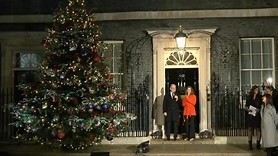 custom is for this to be done on or close to the first day of Advent, which this year was the 1st December. The UK Prime Minister Sir Keir Starmer and his wife switched on the Christmas tree lights outside 10 Downing Street, accompanied by a carol-singing choir, on 2nd December, the same day the tree provided annually by Norway was installed in Trafalgar
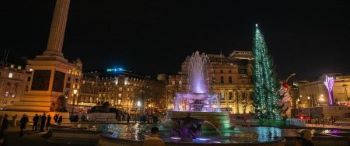 Square. As BBC News has pointed out, however, there’s considerable variation around the UK: In some homes, the decorations go up straight after Halloween (31st October) or Bonfire Night (5th November) whereas others wait until later in December.
When they should be taken down again is even more of a contentious issue. It’s said to bring bad luck if  they are left up after “Twelfth Night”, though there’s disagreement as to whether this means the 5th or 6th January. The English Heritage charity considers it’s
 perfectly reasonable for the display to remain until Candlemas (this year 2nd February), which, they say, was regarded as the official end of Christmas in medieval England. A few British residents, such as Andy Park of Melksham,Wiltshire and Vicki Morlet of Langwith, Derbyshire, have resolved this problem by never removing their festive adornments.
 In these ecologically-conscious times, nonetheless, certain types of decorations are no longer considered acceptable. As the Guardian contributor, Zoe Wood, emphasised on 5th October, the European Commission’s 2023 ban on loose glitter, which is basically a microplastic
 used mainly to add sparkle to items such as decorations and party hats, doesn’t apply in the UK because of Brexit. Indeed,
  many major UK outlets, such as Morrisons, Waitrose, John Lewis, Boots, Marks & Spencer and Sainsbury preceded the EU law by removing glitter from their Christmas offerings in 2022. Hence, campaigners in Britain are now focusing more on tinsel which, like glitter, declares the “Green Corridor Network” (GCN), poses an equally significant environmental threat.
Daniela Bqain, the manager of the Finnish/Swedish company Stora Enso, a leading provider of renewable products, has explained to Vogue Scandinavia, that tinsel is usually made of fossil-based plastic, principally PVC. It’s not easily recycled and during the long degradation process in landfills, releases toxic chemicals into the atmosphere. The best way to enjoy the shimmer of tinsel and glitter 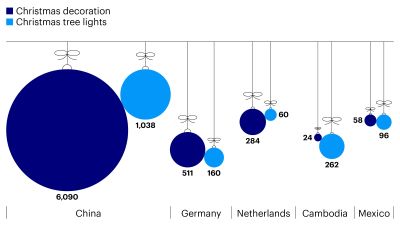 without the guilt (proclaims GCN) is to choose options such as paper tinsel, fabric garlands or reusable bunting. The “Moral Fibres” correspondent, Wendy Graham, on November 22nd likewise recommended eleven eco-friendly tinsel alternatives that she believes look just as good, if not better, than the PVC plastic ones.
According to “visual capitalist”.com, using information provided on the UN Comtrade database, just a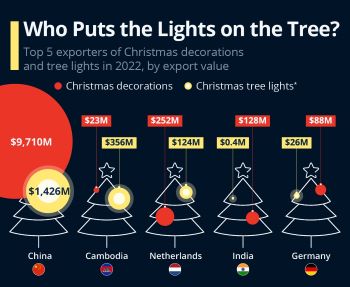 handful of countries dominate the global export of Christmas decorations. China’s 87.6% market share, amounting to over 600,000 metric tonnes in volume, “dwarfs its competitors”, with 80% of its Christmas products being manufactured in Yiwu, a city 175 miles southwest of Shanghai. The Netherlands is a “distant second” with a mere 3.9% (though Statista puts Cambodia
 in 2nd place) and Poland third with 0.91%. The majority of these festive items (58%) are imported into the USA, followed by the UK (5.07%), Canada (5.00%) and Germany (2.99%) .
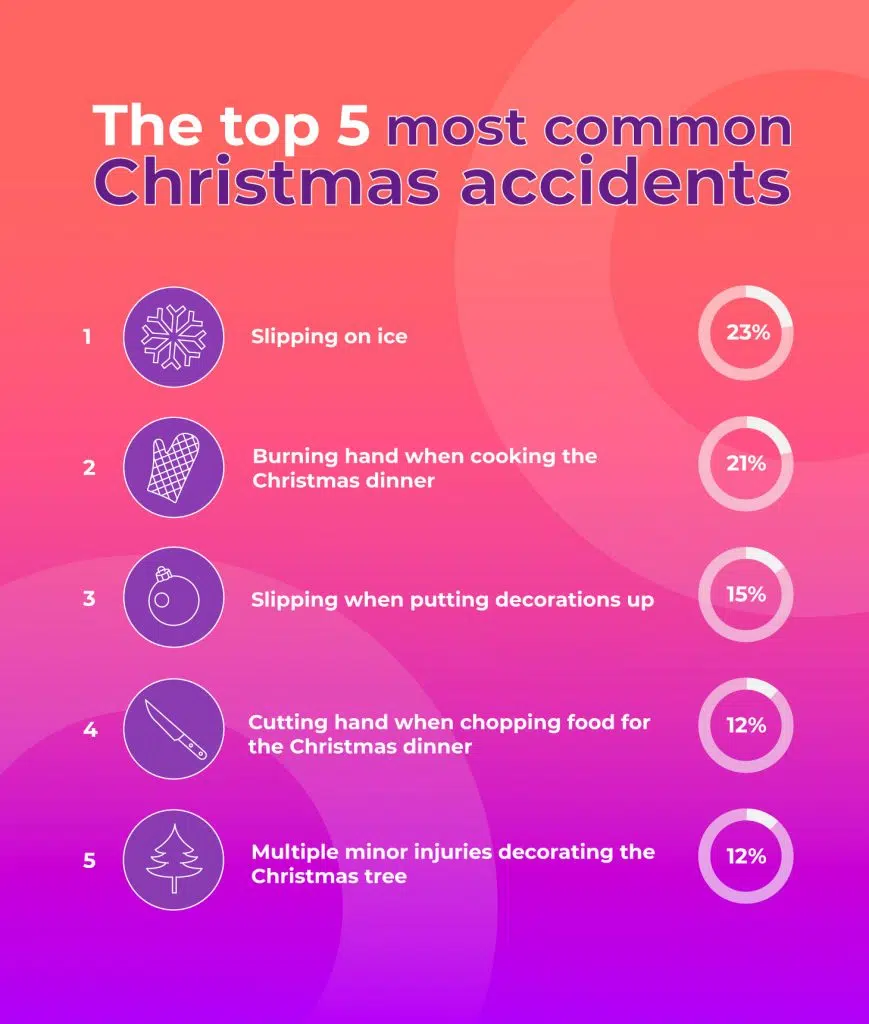 The “Which?” consumer protection website advises caution when putting up decorations (and taking them down again). A survey by the National Accident Helpline has indicated that 1 in 50 persons (2.1%) have fallen from their loft while collecting artefacts stored there
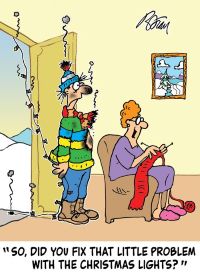
 and another 2.6 million, based on NHS (National Health Service) figures, have slipped from stools or step ladders while hanging up their baubles and garlands. The Royal Society For The Prevention Of Accidents (RoSPA) estimates that every year, about 1,000 people are injured by their Christmas tree, usually while fixing decorations to the highest branches and another 300 by faulty festive lights. Above all, great care needs to be taken when cooking the turkey. Apparently, around 400,000 get burnt every Christmas.