The UK’s Nuclear Deterrent In A Changing World:
 “You could fit the whole British army into Wembley Stadium and
 still have room for some of the French”. This was how the Russian state TV presenter, Dimitry Kiselev, cited by the Mail journalist James Reynolds on March 3rd, contemptuously dismissed the pledge by British Prime Minister Sir
 Keir Starmer “to put boots on the ground and planes in the air” to help maintain a potential ceasefire in the Ukraine war.
 In response, the Live Full Facts website the following day, while acknowledging that the Stadium’s 90,000 capacity could accommodate all the army’s full-time trained personnel, pointed out that this didn’t include the many other service people such as Regular Force soldiers, Gurkhas, volunteer and mobilised reservists and Military Provost Guards, which together bring the number up to 108, 413, thus rendering Kiseley’s jibe completely fallacious. There are also an estimated 37,601 in the Royal Navy and 34,765 in the Royal Air Force (RAF), so combined with the army, that amounts to a total UK military strength of 180,779, a decrease of 2,353 (1.3%) since January 2024.
The contention that the British Army is currently at its smallest size since the
 1792-1815 Napoleonic era is therefore (agrees Live Full Facts) “broadly correct”. That’s precisely why, as the Guardian columnist, Timothy Garton Ash, noted on 15th March, Starmer and French President Emmanuel Macron, having discerned “a long-term trend of US disengagement”, are now working together to establish a “coalition of the willing” to defend Europe. What we need now, declared Ash, is “the spirit of Sir Winston Churchill and President Charles de Gaulle”.
 According to a Forces News survey carried out in January 2024, the UK has 664 military aircraft at its disposal, 531 of which are “in readiness”. This compares with the US total of 13,209 and Russia’s 4,255. The figures for tanks are 213 (UK), 4,657 (USA) and 14,777 (Russia). However, since these statistics were compiled, both Britain and America have handed some of their tanks over to the Ukrainians and the Russians have lost a considerable but unspecified number in battle.

 Meanwhile, following suggestions by commentators such as the historian Mark Felton that the British Army is now too small to effectively perform its tasks and the Royal Navy would struggle to cope with another Falklands crisis, Sir Keir Starmer has announced that his government will increase defence spending initially to 2.5% of GDP by 2027 and then by 3% thereafter. Perhaps by coincidence, the new Armed Forces Minister, Luke Pollard, has declared on a visit to the Falklands that the UK remains capable and committed to protecting the territory’s security and economic prosperity.
 The major concern, though, is whether the UK will continue to
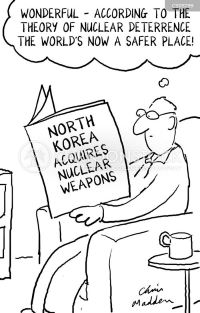 be a credible nuclear power. On 6th March, the BBC News correspondent in Paris, Hugh Schofield, noted President Macron’s proposal that France’s “force de frappe” could provide a defensive umbrella for other European countries. That’s because “the French arsenal is sovereign”, whereas the UK counterpart relies on American technical input. Which is precisely why the British Government is urgently trying to quell speculation about the “terrifying scenario” portrayed by the Mirror contributor Ryan Fahey on 6th March whereby President Trump ends US support for Britain’s nuclear deterrent.
 This could happen if he decides to cancel the co-operation deal
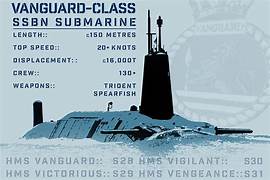
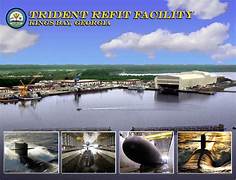 agreed between British PM Harold Macmillan and President Dwight Eisenhower in 1958, or pulls the US out of NATO. Eliot Wilson, an “opinion writer” for the “The Hill”, a Washington-based publication, observed on 14th March that although the Royal Navy’s four Vanguard-class nuclear-powered submarines are built in the UK , the 16
 Trident ballistic missiles that
 they can each carry are manufactured by the American Lockheed Martin company and stored at Kings Bay in Georgia.
 So what happens if Trump refuses to release them or vetoes their use?
 As the former UK ambassador to the US, Sir David Manning, told the Independent newspaper reporter David Hughes, on 6th March, this is no longer inconceivable. The UK Defence Journal has attempted to rebut these fears by insisting that there are no “lock-out” or
  veto controls enabling the US to deny the UK the ability to launch missiles if the Prime Minister authorises their use. Furthermore, they insist that the existing extensive stockpiles, spare components and trained personnel would enable the UK to maintain operational nuclear independence for many years even if the US withdrew from the arrangement.
Meanwhile, America’s traditional allies have already become more cautious about sharing top-secret information with the US, due to alarm about who will be given access to it. This raises questions about the continuation of the “Five Eyes” arrangement established in 1941 between the US, Canada, the UK, Australia and New Zealand
  whereby they collaborate closely on security and global intelligence issues. A top White House aide, Peter Navarro, is now advocating that Canada (which the President has stated he intends to annex) be evicted from the group. The disruption this would cause, the former CIA official, Dennis Wilder, told the Financial Times in February, would be met with cheers from the West’s adversaries in Moscow, Beijing, Tehran and the North Korean capital Pyongyang.