Wealthy But Worried: The Declining Number Of UK’s Billionaires:

 “Íf you believe all your money concerns will disappear if you become rich, think again”. When the Forbes american media organisation’s staff member, Chase Peterson-Withorn, made this observation to accompany the publication of its 2025 “Global Millionaires List” on 1st April, he also pointed out that although the very prosperous don’t have to cope with “day-to-day survival issues”, they
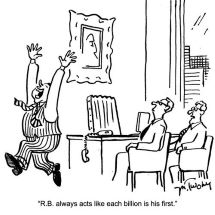 invariably try to build up even more personal wealth “in order to create the kind of financial security that being rich should provide, but doesn’t”. Being affluent, notes the Finance Key online resource, just brings with it more extreme versions of the anxieties that most people with much smaller budgets experience in their daily lives, such as paying their taxes, protecting their assets, avoiding bad investments and not being involved in any form of
 business failure.
It’s this last one, for example, that seems to have convinced TESLA boss Elon Musk that he should stop working for President Trump as a “special government employee”, a decision he announced on 29th May following a significant drop in both the sales of TESLA vehicles world-wide and its stock  market value, along with rumours that the company’s board members were considering replacing him as CEO. Not that the 53-year-old is
 likely to be struggling economically for quite a while yet: Forbes estimate his net worth to be $342 billion, followed by Facebook’s Mark Zuckerberg (40: $216 billion), Jeff Bezos (61: Amazon: $215 billion), Larry Ellison (80: Oracle Database: $192 billion), Bernard Arnault & family (76: LVMH French luxury products group: $178 billion). According to Forbes, the US has a record 902 billionaires, China (including Hong Kong) 516 and India 205.
 It’s a rather different story in the UK, however. This year’s Sunday Times “Rich List”, published on May
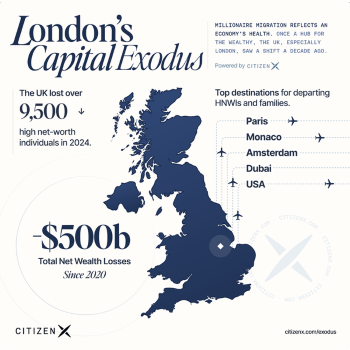 18th shows – as it’s author, the broadcaster and commentator Robert Watts points out – that the combined fortunes of the 350 individuals and families featured in it amount to a total of £772.8 billion, 3% less than in 2024 and that there are now just 156 billionaires based in Britain compared to 165 a year ago and 177 in 2022. Watts attributes this reduction to the “array of tax changes” unveiled in Parliament on October 30th by the
  Labour Government’s Chancellor of the Exchequer, Rachel Reeves. Private company shares worth more than £1 million will incur a 20% charge when passed on to the next generation, a move denounced by the bagless vacuum cleaner inventor Sir James Dyson (No. 4 in the List) as a “cash grab that will rip apart the very fabric of our economy”.
Increases to taxes on capital gains and the income from business sales, but especially the abolition of the “non-dom status” for residents in the country whose domicile for tax purposes is outside Britain, states Watts, constitute an “existential threat” to many “wealth creators” on the Rich List, who are now as a result contemplating moving permanently to more welcoming locations such as Dubai and Singapore or have already done so.
 As the BBC journalists Yang Tian and Imogen James have observed, down from 2024 are both the Gopi Hinduja industrial family, the richest in the
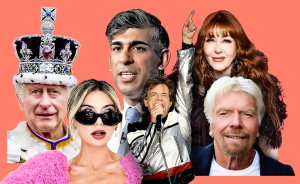 UK (from £37.3 bn to £35.3 bn) and the DAZN sports streaming owner Sir Leonard Blavatnik (No. 3: From £29.246 bn to £25.725 bn), though at No 2 the property magnates David and Simon Reuben are up from £24,977 bn to £26.873bn and Sir James Dyson has
  remained the same at £20.8bn. King Charles III is apparently £270 million better off than was his mother, Queen Elizabeth II (£640 million compared to her £370 million, on which he was exempted from inheritance tax). The biggest loser has been the Manchester United part-owner, Sir James Ratcliffe (No 7: £23.519 bn to £17.046 bn).
 The Finance Monthly website, though, has very little sympathy for
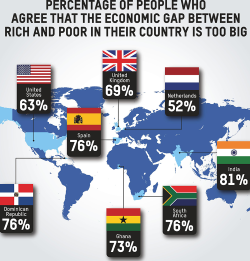
  anyone on the Rich List who’s encountered even a modest downturn. “How can so few hold so much?” it queried on 16th May. In a year of mounting economic pressure, it declares, the latest Rich List offers a jaw-dropping glimpse into the astronomical wealth concentrated in the hands of a select minority while in the rest of the nation more families than ever are having to rely on food banks, housing costs are soaring and public services are under great strain.
Jack Mark, a columnist for the “UK Reporter” highlighted on October 17 an analysis by the Fairness Foundation indicating that the “huge wealth
  gap”between the richest and poorest households in the UK has surged by nearly 50% in under a decade, a development described by the Foundation’s CEO, Will Snell, as “ a moral outrage and a clear danger to our society”. On 16th May, the BBC’s cost of living correspondent
  Kevin Peachey cited a Financial Conduct Authority (FCA) survey suggesting that 25% of the UK adult population (around 13 million people) are “walking a financial tightrope”, have debts that are difficult to manage, have problems in paying even their essential bills and have either low savings or none at all.